[OT Security] “OT Security Consultant Career Lifespan: 4 Data-Backed Signals on How Many Years Are Left”


OT Security Consultant Career Lifespan: 4 Data-Backed Signals on How Many Years Are Left
Why every OT security consultant is asking this question now
One question I hear more and more from junior colleagues on site assessments goes like this: “If AI can draft the asset inventory and write the first version of the report, will the OT security consultant still exist ten years from now?” To be honest, I have asked myself the same thing more than once. If prioritizing security controls for PLCs and HMIs on a production line can one day be handled by a single model, where does the expertise we are building today actually go?
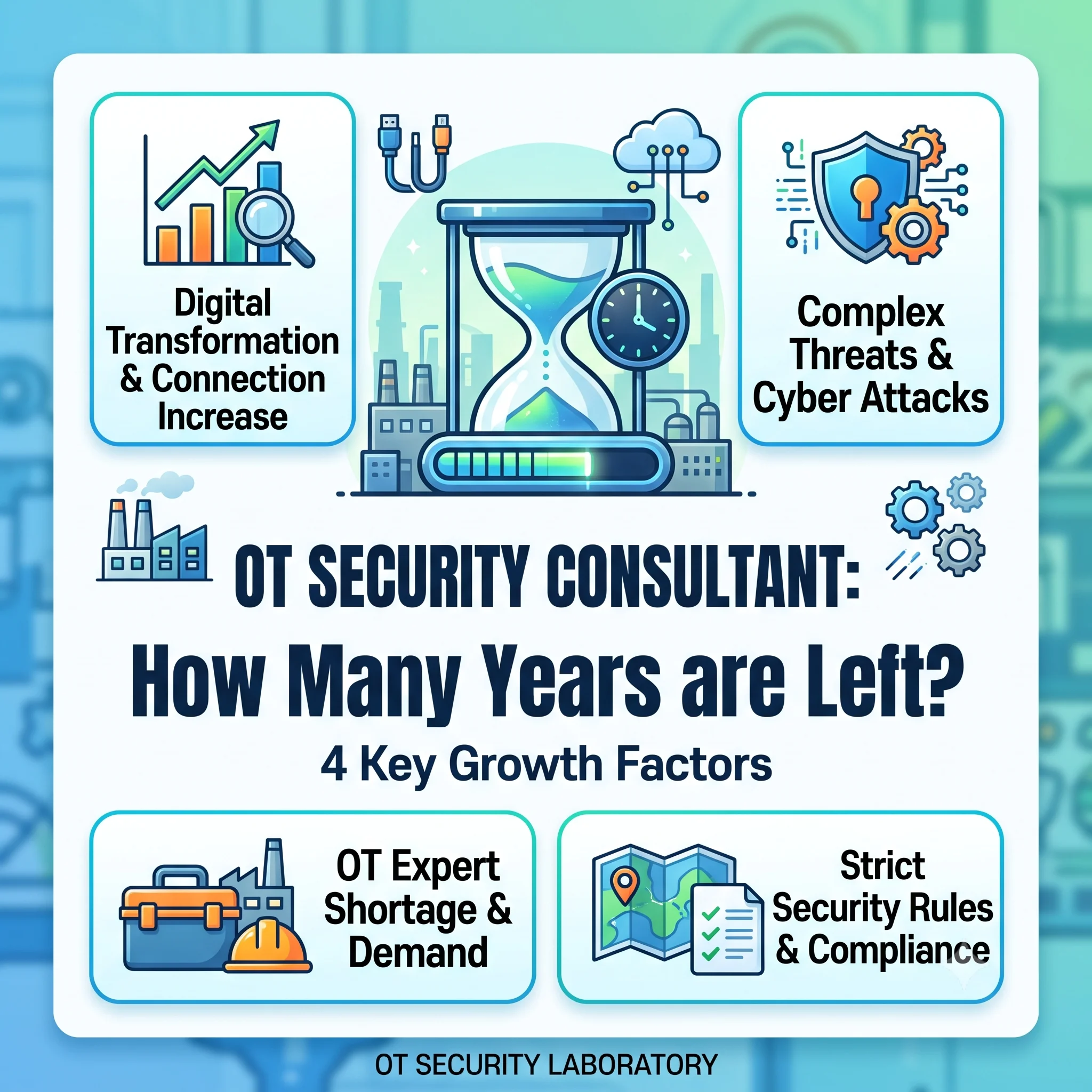
So instead of vague optimism or anxiety, this article looks at the lifespan of the OT security consultant role using published primary sources only. It covers four axes: the threat landscape, the regulatory calendar, the talent market, and the way AI is reshaping the work. To give away the direction of the answer early, the variable that matters is not whether the job disappears, but which parts of the job stay with people. The infographic below summarizes the whole argument on a single page.
The question feels heavy because the work of an OT security consultant has always leaned on field experience. Spreading out plant drawings, tracing network paths with operators, and planning assessments around the few hours a line can safely stop are things you learn on the plant floor, not from a textbook. Below, I try to assess honestly, as a working OT security consultant, how the value of that experience changes in front of AI.
Signal 1. Attackers are already mapping control loops
The first signal for any OT security consultant is where threats are heading. Dragos reports that in 2025, 119 ransomware groups hit 3,300 industrial organizations, a 49% increase from 80 groups in 2024, and that manufacturing accounted for more than two-thirds of victims. [Dragos, 2026]
What weighs more than the numbers is the change in the nature of attacks. The same report finds that adversaries have moved beyond pre-positioning and are now working out how to manipulate physical processes.
This matches what I see in the field. Dragos notes that many incidents are mislabeled as “IT incidents” when the compromised Windows servers host SCADA software or engineering tools, so the real scale of OT ransomware is likely far higher. On assessments, I often find line stoppages recorded simply as server failures, with no root cause analysis from a security perspective.
Dragos also points out that in most cases a compromise becomes visible only after the process starts behaving abnormally, and that only a small number of OT networks can detect reconnaissance and lateral movement earlier. [Dragos, 2026] In other words, fundamentals such as visibility, segmentation, and remote access control are still wide open. Designing those fundamentals without stopping production is exactly where an OT security consultant spends most of their time, and in a market with this much basic work left, specialist demand is unlikely to shrink first.
The implication for the OT security consultant is clear. As attacks shift from data theft to process manipulation, organizations need people who can read control loops, safety systems, and availability requirements together, not just firewall rules. The closer threats come to the physical world, the less reason there is for demand for the OT security consultant to fall.
Signal 2. The regulatory clock is already ticking
The second signal, and the one every OT security consultant should track closely, is regulation. In Fortinet’s 2026 survey of more than 700 OT professionals, 89% of respondents expect increased regulation within five years, up from 66% in 2025. [Fortinet, 2026]
That expectation is already becoming reality. The EU Cyber Resilience Act (CRA) entered into force on 10 December 2024, and reporting obligations for actively exploited vulnerabilities and severe incidents have applied since 11 September 2026. Full application, including essential requirements and CE marking, follows on 11 December 2027, and the reporting duty also covers products already on the market. [NCSC Ireland]
For any manufacturer shipping PLCs, HMIs, or industrial gateways with digital elements into the EU, this calendar is not someone else’s problem. When I discuss compliance with clients, the first reaction is usually, “We are not even sure our products are in scope.” Scoping, vulnerability handling process design, and secure development programs all require someone who can translate legal text into the language of processes and products, and that is where the OT security consultant earns a place.
Many organizations still treat compliance as a one-off certification project. But the CRA reporting duty demands an early warning within 24 hours, which makes it an operating model problem: product security, quality, and customer support have to move as one process. Designing the seams between teams is human work, and it is where an OT security consultant adds the most value on regulatory projects.
Regulations rarely disappear once written, and every revision creates fresh demand for interpretation and implementation. With a dense regulatory schedule running through the end of 2027, I see little chance that demand for the OT security consultant will turn down in the medium term.
Signal 3. The shortage is skills, not headcount
The third signal is the talent market, both for the OT security consultant and for the wider security workforce. ISC2’s 2025 study of more than 16,000 practitioners found that 95% of respondents have at least one skills gap on their team, and 59% describe those gaps as critical or significant, up sharply from 44% in 2024. ISC2 concludes that skills, not headcount, are now the bigger problem. [ISC2, 2025]
Long-term projections point the same way for anyone building a career as an OT security consultant. The U.S. Bureau of Labor Statistics projects employment of information security analysts to grow 21% from 2025 to 2035, much faster than the average for all occupations, with about 14,100 openings each year. [BLS] The World Economic Forum adds that 85% of organizations with insufficient cyber resilience also report missing critical skills and people. [WEF, 2026]
These figures cover the security workforce as a whole, but the gap gets sharper once you narrow it to OT. In hiring interviews, I meet many candidates with solid IT security backgrounds who have never read PLC logic or an industrial protocol capture. The reverse also happens: engineers who know process control deeply but cannot express it in the language of risk assessment and security architecture. That is why an OT security consultant who can bridge both worlds remains rare.
In the ISC2 study, the most-cited skills needs were AI (41%) and cloud security (36%), followed by risk assessment (29%). [Infosecurity Magazine] Risk assessment sits at the core of what an OT security consultant does every day. Add an understanding of smart factory environments connected to AI and cloud, and you match exactly the skill mix the market is searching for. That is why I encourage junior colleagues to layer AI security skills on top of their OT expertise.
Signal 4. AI reshapes the work more than it replaces it
The last signal is probably the one readers care about most. Will AI replace the OT security consultant? In the ISC2 study, 28% of respondents had already integrated AI tools into their work, and 69% were somewhere in the adoption process, including testing and evaluation. Yet 73% said AI will create more specialized cybersecurity skills. [ISC2, 2025]
OT maturity data explains why the OT security consultant is not going away. In Fortinet’s 2026 report, the share of organizations rating themselves at the highest maturity level (Level 4) fell from 49% to 17% in a single year, which Fortinet reads as a correction: better tools and visibility exposed gaps that were previously hidden. Only 14% had full visibility into their OT systems, and about 23% could see only around half of their environment. [Fortinet, 2026]
Equipment refresh is also worth watching. In the same report, the share of respondents whose ICS is less than five years old doubled from 20% in 2025 to 40% in 2026. New systems bring connectivity, remote access, and cloud integration with them, so security has to be designed in from the start. With compensating controls needed for legacy assets and secure design needed for new ones at the same time, the scope of the OT security consultant is getting wider, not narrower.
On top of that comes the long life cycle of OT equipment. As long as old and new systems run side by side on the same line, designing compensating controls for unpatchable assets, weighing downtime costs against security measures, and aligning with process owners remain decisions a model cannot make for us. In my view, repetitive tasks such as drafting asset inventories, first-pass log analysis, and first drafts of reports will be automated quickly, and the OT security consultant’s time will shift toward judgment and design.
So how long does the OT security consultant role have left?
Put the four signals together and the answer becomes clearer. Attacks are heading for the process, the regulatory calendar runs through the end of 2027, the talent market is short on skills rather than bodies, and AI is increasing demand for specialized expertise. So here is my view: I find no evidence that demand for the OT security consultant will decline, at least through 2035, the end of the BLS projection period. However, the lifespan of an OT security consultant who only fills in checklists may be much shorter.
What needs managing, then, is not the lifespan of the job but the shelf life of your skill set. The OT security consultant who lasts keeps renewing three things. First, the ability to translate standards such as IEC 62443 and NIST SP 800-82 into the language of process risk. Second, the ability to interpret new regulations such as the CRA from both the product and the operations side. Third, the habit of using AI tools as an assistant that takes over repetitive work rather than as a competitor, and investing the time saved in judgment and design.
One caveat: this view rests on public data and field experience. In a downturn, when security budgets shrink, consulting demand can dip temporarily, and 36% of ISC2 respondents reported budget cuts. [ISC2, 2025] What an OT security consultant needs is not complacency but a strategy to become the person an organization calls first even when budgets are tight.
If a junior colleague asked me the same question today, I would answer this way: “The job will remain. But the OT security consultant of ten years from now will be doing different work.” The OT security consultant who reads the direction of that change first will enjoy the longest career in this field.
References
- Dragos, 2026 OT Cybersecurity Year in Review
- Dragos, 2026 OT Cybersecurity Report: A Year in Review
- Dragos, 2026 OT/ICS Cybersecurity Report press release (Feb 17, 2026)
- Fortinet, While OT Security Is Maturing, Risk Is Not Slowing Down (Jun 9, 2026)
- Fortinet, 2026 State of Operational Technology and Cybersecurity Report
- NCSC Ireland, EU Cyber Resilience Act
- ISC2, 2025 Cybersecurity Workforce Study announcement (Dec 4, 2025)
- ISC2, AI Security Skills
- Infosecurity Magazine, Skills Shortages Trump Headcount as Critical Cyber Challenge
- U.S. Bureau of Labor Statistics, Information Security Analysts
- World Economic Forum, Global Cybersecurity Outlook 2026
- NIST, SP 800-82 Revision 3 Guide to OT Security
- Industrial Cyber, coverage of NIST SP 800-82r3 publication


![[OT Sec] “OT Control System I/O List Security Management Guide: Practical Manual for Insider Threat Response”](https://ota2z.com/wp-content/uploads/2025/07/ChatGPT-Image-2025년-7월-16일-오후-01_06_28-768x768.webp)