[AI Data Center Security] “NIST SP 800-82 OT Overlay for AI Data Centers: 4 Control Mappings That Survive Contact With Real Facilities”


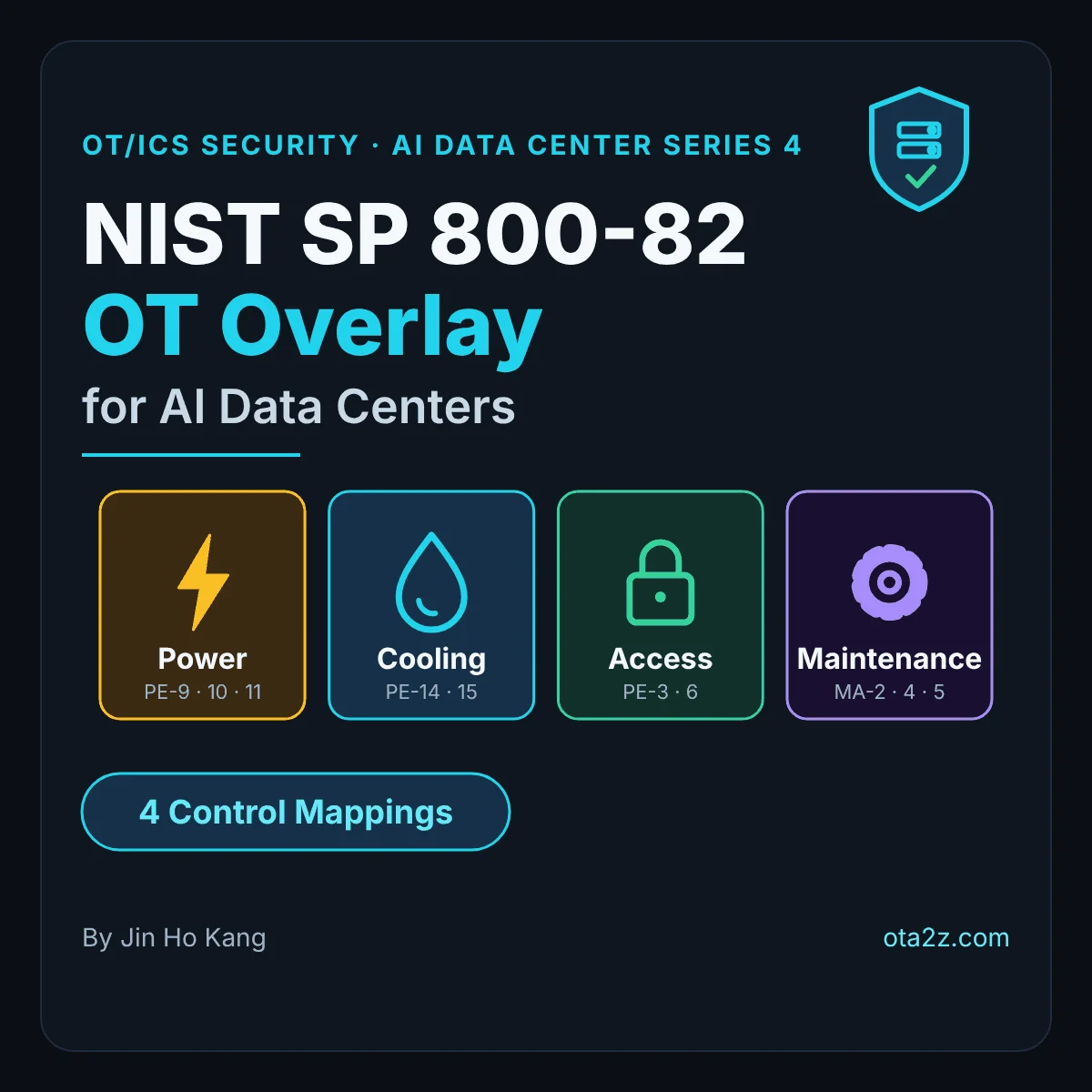
NIST SP 800-82 OT Overlay for AI Data Centers: 4 Control Mappings That Survive Contact With Real Facilities
By Jin Ho Kang · OT/ICS Security Consultant
Table of Contents
- Why AI Data Centers Need the NIST SP 800-82 OT Overlay Now
- What the NIST SP 800-82 OT Overlay Adds to SP 800-53
- Mapping PE Controls to Power, Cooling, and Physical Access
- MA Controls: Maintenance as the Quiet Attack Path
- Where the NIST SP 800-82 OT Overlay Needs Judgment
- Bringing It Together
- References
A hyperscale AI campus is usually described in megawatts and GPU counts, but the systems that keep it alive are the ones nobody brags about: transfer switches, coolant distribution units, badge controllers, and the building management system that ties them together. Those are operational technology, and NIST already publishes a control catalog built for operational technology. SP 800-82 Rev. 3 includes an OT overlay that tailors SP 800-53 controls for environments where availability and physical consequences outrank confidentiality. NIST wrote it for industrial control systems, not for data centers, so applying the NIST SP 800-82 OT overlay to an AI data center is my proposal, not NIST guidance. This piece walks through four mappings – power, cooling, physical access, and maintenance – and shows where the NIST SP 800-82 OT overlay helps and where it needs judgment.
Why AI Data Centers Need the NIST SP 800-82 OT Overlay Now
The scale argument for the NIST SP 800-82 OT overlay is already settled. The International Energy Agency reports that data centres used about 415 TWh of electricity in 2024, roughly 1.5% of global consumption, and projects that figure to more than double to around 945 TWh by 2030 (IEA, 2025). At rack level, Gigabyte lists its GB200 NVL72 at up to 130 kW with direct liquid cooling (Gigabyte), which means coolant flow is now as critical to a rack as electricity. Uptime Institute’s 2025 outage analysis adds the cost side: 54% of operators said their most recent significant outage cost more than $100,000, one in five put it above $1 million, and outages caused by failure to follow procedure rose ten percentage points in a year (Uptime Institute, 2025). Power, heat, access, and maintenance are exactly the territory of the PE and MA families, which is why the NIST SP 800-82 OT overlay is a sensible starting point for AI facilities rather than a niche reference for refineries. If a single hall can carry this much power and heat per rack, the discipline that governs how those systems are protected, approved, and maintained deserves the same engineering rigor that the compute itself receives, and the NIST SP 800-82 OT overlay supplies a vocabulary for it.
Fig. 1 – Four numbers that explain why the NIST SP 800-82 OT overlay fits AI data centers (IEA, Gigabyte, Uptime Institute)
What the NIST SP 800-82 OT Overlay Adds to SP 800-53
SP 800-82 Rev. 3, published in September 2023, broadens the scope from industrial control systems to operational technology generally and carries an overlay that starts from the SP 800-53 Rev. 5 low, moderate, and high baselines (NIST, 2023). What the NIST SP 800-82 OT overlay contributes is not a new control list but OT-specific discussion, tailoring advice, and control enhancements that explain how an IT-style control must change before it is safe on a system that moves physical equipment. That principle matches what I found in my doctoral research (N=100): IT-centric controls showed a negative association with availability in OT environments, which is why I organized 39 controls into a 13-item framework instead of transplanting an IT checklist. The control-by-control guidebook I built from SP 800-82 is the working material for the mappings below, and the NIST SP 800-82 OT overlay is the reason each mapping asks “what does this control do to uptime?” before “is it implemented?” That ordering matters in practice, because a control that is technically implemented but quietly degrades availability will be switched off by operators within weeks, leaving the facility worse off than before the control existed.
Fig. 2 – From SP 800-53 baseline to a verified data center control: how the NIST SP 800-82 OT overlay is applied
Mapping PE Controls to Power, Cooling, and Physical Access
Under the NIST SP 800-82 OT overlay, the PE family covers physical and environmental protection, and in a data center it splits naturally into three systems. For power, PE-9 (power equipment and cabling), PE-10 (emergency shutoff), and PE-11 (emergency power) translate to UPS, automatic transfer switches, generators, and the emergency power-off circuit; in an AI hall an unguarded EPO or a transfer-switch controller reachable from the wrong network segment can end a multi-week training run in seconds. For cooling, PE-14 (environmental controls) and PE-15 (water damage protection) map to coolant distribution units, chillers, and leak detection, and at 130 kW per rack the coolant loop is a failure path, not an amenity. For access, PE-3 (physical access control) and PE-6 (monitoring physical access) map to badge controllers, cameras, and mantraps, with the NIST SP 800-82 OT overlay mindset adding one question: these controllers sit on a network, so a cyber compromise can produce a physical entry. Read this way, the NIST SP 800-82 OT overlay turns three separate facilities disciplines into one control vocabulary that security and facilities teams can both audit against. A shared vocabulary also shortens the usual argument over who owns a given finding, since the same control identifier now points to a named piece of equipment and a named owner.
Fig. 3 – Mapping PE and MA controls to AI data center systems under the NIST SP 800-82 OT overlay (author’s proposal)
MA Controls: Maintenance as the Quiet Attack Path
Maintenance is where facilities reality and security policy collide, and the NIST SP 800-82 OT overlay treats it as a first-class concern. SP 800-53 MA-4 requires an organization to approve and monitor nonlocal maintenance, use strong authentication when establishing the session, keep records of the activity, and terminate the session and network connections when the work is finished (NIST SP 800-53 Rev. 5, MA-4). In a data center that describes the remote session a chiller, UPS, or BMS vendor opens to diagnose a fault, and the NIST SP 800-82 OT overlay frames it as a controlled lifecycle rather than a standing VPN account. MA-2 (controlled maintenance) and MA-5 (maintenance personnel) cover who may touch equipment and when, while MA-6 (timely maintenance) reminds operators that deferring a repair is also a risk decision. Uptime Institute’s ten-point rise in procedure-related outages shows why the lifecycle must be written into the approval itself, including which workloads a maintenance window can affect, so the NIST SP 800-82 OT overlay becomes a procedure people can follow under pressure. Sessions that get abused are rarely the ones that were approved and monitored; they are usually the ones left open because closing them was nobody’s explicit step.
Fig. 4 – A nonlocal maintenance session lifecycle based on MA-4, applied to a data center BMS vendor
Where the NIST SP 800-82 OT Overlay Needs Judgment
Honesty about limits is what makes a NIST SP 800-82 OT overlay mapping usable. The NIST SP 800-82 OT overlay was written for industrial control systems, and a hyperscale facility differs from a process plant in scale, in vendor concentration, and in how much redundancy sits behind each system, so the baselines should be tailored rather than adopted wholesale. The control names above follow SP 800-53 Rev. 5 and should be checked against the source text before they enter an audit scope. Enforcement also needs testing: a strict session timeout or an authentication step that locks out a technician during an incident is a security control that damages availability, the exact failure my research warns about. The practical sequence is to map the controls, pilot them in a non-production hall, measure the availability effect, and only then roll the NIST SP 800-82 OT overlay out to production halls. Teams that skip the pilot tend to discover the availability cost during an incident, which is the worst possible time to learn that a control and an operating procedure disagree.
Bringing It Together
Power, cooling, physical access, and maintenance are the four places where the NIST SP 800-82 OT overlay earns its place, because they are the four places where an AI data center behaves like the industrial plants SP 800-82 was written for. The NIST SP 800-82 OT overlay gives security and facilities teams a shared control language for them, and the PE and MA families supply the specific controls to start with. It does not replace judgment: map deliberately, test the availability impact, and keep the mapping labeled as an adaptation. Done that way, the NIST SP 800-82 OT overlay is less a compliance exercise than a practical way to protect the infrastructure that every GPU depends on.
References
- IEA, “Energy and AI: Executive Summary” (2025)
- Gigabyte, “GIGAPOD NVIDIA GB200 NVL72” product page
- Uptime Institute, “Annual Outage Analysis 2025” (press release)
- NIST, SP 800-82 Rev. 3, “Guide to Operational Technology (OT) Security” (2023)
- NIST SP 800-53 Rev. 5, MA-4 Nonlocal Maintenance (csf.tools reference)

![[네트워크] 네트워크 전문가를 위한 OSI 7계층 실무 가이드: 우체국 시스템으로 이해하는 네트워크 아키텍처](https://ota2z.com/wp-content/uploads/2025/08/ChatGPT-Image-2025년-8월-15일-오후-03_39_56-768x768.webp)
![[OT Sec] Analysis of the EU Cyber Resilience Act (CRA): Security Requirements and Regulatory Impacts on Digital Products](https://ota2z.com/wp-content/uploads/2025/03/DALL·E_2025-02-19_14.50.11_-_CRA_security_requirements__A_digital_factory_se-768x439.webp)
![[OT보안] “OT 제어시스템 I/O 리스트 보안 관리 가이드: 내부자 위협 대응을 위한 실무 매뉴얼”](https://ota2z.com/wp-content/uploads/2025/07/ChatGPT-Image-2025년-7월-16일-오후-01_06_28-768x768.webp)

![[OT Sec] Measures for Cultivating OT Security Experts (1/3)](https://ota2z.com/wp-content/uploads/2025/02/DALL·E_2025-02-03_12.44.29_-_A_dynamic_visual_representation_of_OT_security_-768x439.webp)