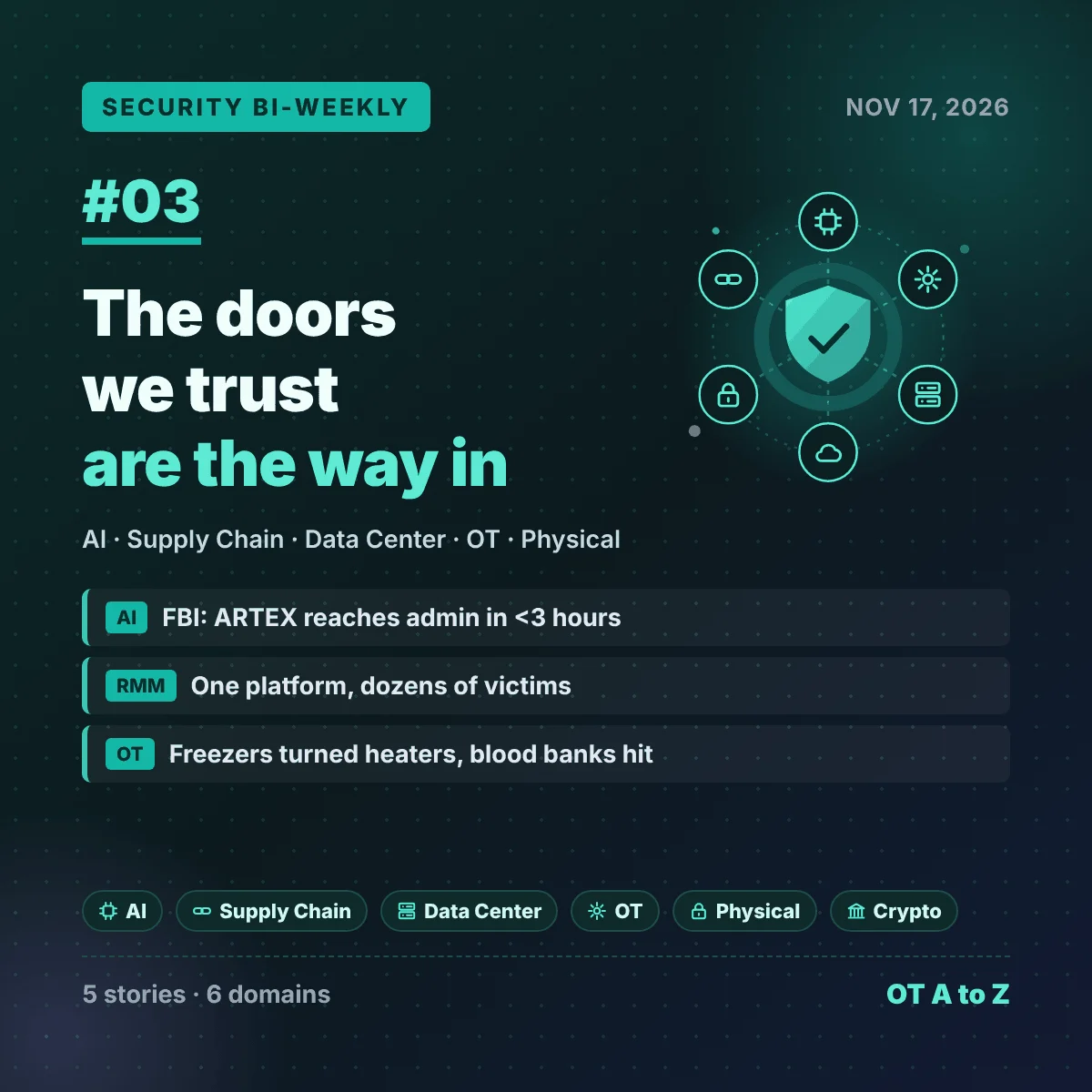
[Security Bi-Weekly #03] ‘When Security Tools Become the Attack Path: 5 Doors We Trusted Too Much’


Defend: Detect threats faster and contain their spread.
Thwart: Prepare early for risks that will grow over time.
* The Secure, Defend, and Thwart lenses come from the NIST Cyber AI Profile (NISTIR 8596), which extends the NIST Cybersecurity Framework (CSF) 2.0 to AI environments. This newsletter applies the same three lenses across all security domains, not only AI.
- [AI Security] ‘FBI: an open-source AI pentest tool is now hacking at machine speed’
- [Supply Chain · RMM] ‘Remote management platforms became the fastest route into dozens of companies’
- [Data Center · Network] ‘A security gateway became the first step toward wiping a virtualization host’
- [OT Security] ‘Supermarket freezers turned into heaters: fridge controller attacks reach blood banks’
- [Physical · Supply Chain] ‘A genuine hardware wallet, a trusted reseller, and a hidden board that reads your keys’
This Issue’s Perspective
Every story in this issue entered through something that was supposed to be trusted. An open-source penetration testing framework built for defenders is now, according to the FBI, automating intrusions for criminals and state groups. Remote management platforms that IT providers use to look after hundreds of customers became the fastest route into all of them. A security gateway was used as the first step toward wiping a virtualization host. Refrigeration controllers installed and managed by suppliers turned supermarket freezers into heaters. And a genuine hardware wallet, bought from what looked like a legitimate reseller, arrived with a hidden board that reads its recovery words.
Trust is not the problem. Unverified trust is. Most organizations grant their security tools, management platforms, and suppliers the widest access in the environment and then watch them the least. The question for leaders this issue is direct: which of our trusted tools and partners could do the most damage if they were turned against us, and who is watching them?
Top Security Stories
1. [AI Security] ‘FBI: an open-source AI pentest tool is now hacking at machine speed’
What happened
On November 13, 2026, the FBI issued a FLASH alert on ARTEX, an open-source penetration testing platform that can be paired with any large language model to automate intrusions from reconnaissance to data theft. According to The Record, the FBI said some intrusions progressed from initial targeting to privileged access in under three hours, and that the framework lets actors with minimal technical skill run complex, multi-target attacks. Censys found more than 1,600 publicly exposed ARTEX consoles, and the FBI believes real deployments are much higher.
ARTEX was posted to GitHub in August. Its developer acknowledged abuse and removed the repository on October 8, but the FBI says it still spreads through forks, modified versions, archived copies, and a commercial version. Both criminals and state-linked groups use it, and it has been tied to attacks on South Korean and Japanese financial institutions. A Cloud Security Alliance research note links it to the Korean extortion case covered in Issue #02, in which a seven-person group hit more than 90 organizations. The FBI notes that ARTEX targets less-secured systems such as partner portals, third-party integrations, and legacy services.
Why it matters
ARTEX removes two things defenders have long relied on: the attacker’s skill and the attacker’s time. When an AI framework chains scanning, exploitation, credential abuse, and data staging automatically, the gaps that used to be safe because they were obscure or tedious to exploit become reachable in hours. The FBI’s note about partner portals and legacy services matters most. These are the systems that sit outside core security programs, often with weaker monitoring, and they are exactly where an automated attacker will look first.
- ARTEX: An open-source, multi-agent AI penetration testing framework. Built for authorized security testing, it is now widely misused by attackers.
- FLASH alert: A short, urgent FBI notice that shares indicators and techniques about an active threat with organizations.
- Multi-agent framework: Software in which several AI agents split a task, such as one planning and others running tools, and share findings.
- Privileged access: Administrator-level control over systems, which lets an attacker change settings, create accounts, or move freely.
- Attack surface: Everything an attacker can reach and try to exploit, such as websites, portals, remote access, and APIs.
- Penetration testing: Authorized, simulated attacks run to find weaknesses before real attackers do.
2. [Supply Chain · RMM] ‘Remote management platforms became the fastest route into dozens of companies’
What happened
A researcher published more than 30 alleged zero-day vulnerabilities in N-able’s N-central remote monitoring and management (RMM) platform around November 8, 2026, prompting N-able to take its hosted N-central service offline. After N-able shipped fixes, the same researcher released a follow-up chain, 4EverAble2Shell, with proof-of-concept code on November 12. Security firms Lupovis and Huntback reported successful compromises about five hours later. The only payload seen so far is a cryptocurrency miner, and Huntback reports that 19 victims had applied N-able’s latest patches. N-able restricted its Legacy API and Intune integration on November 13.
In the same week, a separate campaign hit ConnectWise ScreenConnect partners. Attackers compromised six managed service providers (MSPs), installed rogue ScreenConnect clients, and reached more than 286 endpoints across 47 downstream organizations. Five third-party extensions were disabled across about 400 partner environments. The initial entry point has not been established.
Why it matters
An RMM platform is designed to reach every managed device with administrator rights. That makes it the most efficient tool an attacker can capture, because one compromise fans out to every customer of the provider. The N-central case adds a second lesson: patched does not always mean protected. When a disclosure is still unfolding, a hotfix may cover only part of the problem, and the gap between a public exploit and real attacks is now measured in hours, not weeks.
- RMM (Remote Monitoring and Management): Software that IT providers use to monitor, patch, and control many customers’ computers from one console.
- MSP (Managed Service Provider): A company that runs IT or security operations for other organizations under contract.
- Zero-day: A vulnerability with no available fix at the time it becomes known or is exploited.
- Proof of concept (PoC): Working code that demonstrates a vulnerability can be exploited; once public, attackers can reuse it quickly.
- Hotfix: A quick, targeted patch released to address an urgent issue, which may not fully resolve every related flaw.
- Downstream organization: A customer that depends on a provider, and is therefore exposed when that provider is compromised.
3. [Data Center · Network] ‘A security gateway became the first step toward wiping a virtualization host’
What happened
Check Point Research published an analysis on November 12, 2026, of attacks on Check Point Security Gateways with a Mobile Access portal. The attacker used PHP2Shell (CVE-2026-109618 and CVE-2026-109619) for initial access, then a privilege escalation flaw, CVE-2026-123039, to reach root. It placed web shells, deployed a backdoor called TSGA, and moved over SSH to a VMware ESXi host, where it ran a wiper that deletes files and left a note rejecting ransom negotiations.
The first wave began on October 30 and hit Israeli organizations, with some destructive activity. A second wave from November 2 hit organizations in multiple countries and sectors, with no destruction observed. Fixes for PHP2Shell were available about a week before the first wave. Check Point said it cannot assess the operation’s true nature with high confidence, and listed a false flag as one possibility. CISA added CVE-2026-123039 to its Known Exploited Vulnerabilities catalog on November 13.
Why it matters
Security gateways sit at the edge of the network with deep visibility and privileged connections inward. Once controlled, they become a trusted launch point rather than a barrier. The move to VMware ESXi is what turns an intrusion into a business outage: one hypervisor can host dozens of servers, so wiping it removes many systems at once. The one-week gap between fix and first attack shows how little time edge devices now get before exploitation.
- Security gateway: A device at the network edge, such as a firewall or VPN, that controls and inspects traffic entering and leaving.
- Hypervisor (VMware ESXi): Software that runs many virtual servers on one physical machine; losing it takes all of them down.
- Wiper: Malware designed to destroy data rather than steal or encrypt it.
- Privilege escalation: Turning limited access into higher-level control, such as root.
- KEV (Known Exploited Vulnerabilities): CISA’s catalog of vulnerabilities confirmed to be exploited in real attacks, used to prioritize patching.
- False flag: An attack designed to look as if someone else carried it out.
4. [OT Security] ‘Supermarket freezers turned into heaters: fridge controller attacks reach blood banks’
What happened
On November 5, 2026, CISA, the FBI, HHS, USDA, and the Department of Transportation warned that attackers are targeting industrial refrigeration and cold-chain monitoring systems worldwide. They exploit unpatched or internet-accessible temperature and refrigeration controllers, using authentication bypass flaws, code injection, or weak configurations to change temperature settings and force continuous heating or defrost cycles.
The warning followed a series of European attacks. In October, attackers compromised refrigeration controllers at an estimated 250 to 350 French supermarkets. A second wave reported in November affected more than 115 stores across six European countries; some systems shut down entirely and others reached 50°C. On November 3, France’s blood service (EFS) confirmed that an incident at a refrigeration equipment provider altered temperature and defrost settings at three blood storage facilities. Censys found that of 6,695 exposed refrigeration controllers seen on October 9, 3,124 (47%) were still reachable on November 5.
Why it matters
This campaign shows OT attacks do not need to steal data or encrypt files to cause harm. Changing a setpoint is enough to destroy inventory, shorten equipment life, create fire risk, and in the case of blood storage, threaten patient safety. Many of these controllers are installed and remotely managed by service providers, so the store or hospital may not even know they are online. The drop in exposed devices shows that remediation works, but it also shows that half remained reachable a month after the first wave.
- Refrigeration controller: An electronic device that sets and maintains temperatures for fridges, freezers, and cold rooms, often with a web interface.
- Cold chain: The temperature-controlled path that food, medicine, or blood follows from production to use.
- Defrost cycle: A mode that warms cooling coils to melt ice; forced continuously, it raises the temperature of stored goods.
- Setpoint: The target value, such as a temperature, that a control system tries to maintain.
- Authentication bypass: A flaw that lets someone use a protected function without valid login.
- Default password: A factory-set password published in manuals, which attackers try first.
5. [Physical · Supply Chain] ‘A genuine hardware wallet, a trusted reseller, and a hidden board that reads your keys’
What happened
Hardware wallet maker Trezor confirmed on November 12, 2026, that three Trezor Safe 5 devices bought from Indonesian reseller CryptoBilis contained a malicious implant. One was reported in October, and two were identified from owners’ photos. The devices were bought between August 20 and September 23 through CryptoBilis’s Tokopedia and Shopee stores or directly from the reseller.
The implant is an extra circuit board between the main board and the screen. It copies what appears on the display, including recovery words, backups, and passphrases, encrypts the data, and sends it over the mobile network to attacker servers, retrying if offline. It does not alter the firmware or the Secure Element. Firmware 2.13.1, released November 11, blocks the current implants on updated devices but cannot protect backups captured earlier. No customer has reported lost funds. Trezor cut its reseller network by about 80% and tightened rules on sourcing, storage, and access.
Why it matters
This is a physical supply chain attack that defeated a device designed around tamper resistance, without touching its security chip. The weak point was not the product but the path it took to the buyer. The same pattern applies to any hardware that reaches a site through distributors or integrators: network appliances, PLCs, badge readers, or servers. If a device can be opened and reassembled in transit, its security depends on who handled it, not only on how it was designed.
- Hardware wallet: A small device that stores the keys to cryptocurrency offline and signs transactions.
- Recovery phrase (seed): A list of words that can rebuild a wallet and control all its funds; anyone who sees it can take them.
- Implant: Hidden hardware added to a device to spy on it or alter its behavior.
- Secure Element: A tamper-resistant chip that stores secrets inside a device.
- Chain of custody: A record of everyone who handled an item, used to show it was not tampered with.
- Reseller: A third party that sells a manufacturer’s products; its handling practices affect product integrity.
Bi-Weekly Summary
This issue in one line: the most trusted tools and channels now carry the most risk, because they carry the most access.
- The FBI warns that ARTEX, an open-source AI pentest framework, is automating intrusions, some reaching privileged access in under three hours.
- N-able N-central and ConnectWise ScreenConnect attacks show how one remote management platform can expose dozens of downstream organizations.
- Attackers chained PHP2Shell on Check Point gateways to root access and, in some cases, a wiper on VMware ESXi.
- Refrigeration controller attacks hit 115+ European stores and three French blood storage sites, prompting a five-agency US warning.
- Trezor confirmed hardware implants in three Safe 5 wallets sold by a reseller, and cut about 80% of its reseller network.
Share it with a colleague who owns security, infrastructure, or risk decisions. The next issue will be published in two weeks.
Further Reading
- The Record – FBI flash alert says Artex tool automating cyberattacks at machine speed
- Cloud Security Alliance – Multi-agent offensive frameworks in the wild: CyberStrikeAI and ARTEX
- CybelAngel – Cyber Roundup: Week of November 9 (N-able, Check Point, Maileva)
- Senthorus – Cybersecurity Week in Review: November 9-15, 2026
- Check Point Research – PHP2Shell exploitation on Check Point Gateway
- BleepingComputer – FBI, CISA warn of cyberattacks targeting refrigeration systems
- Trezor – Our CryptoBilis investigation: what we found and what we’ve changed


