[OT Sec] Workflow of an OT/ICS Security Consultant


The Importance of OT/ICS Security and the Role of Consultants
As industries digitize and advanced technologies such as smart factories are introduced, the importance of Operational Technology (OT) and Industrial Control System (ICS) security has been increasingly emphasized. OT and ICS are systems that control the operations of critical industries such as manufacturing, refining/chemical, energy, transportation, and logistics. While these systems maximize productivity and efficiency, they also pose significant risks when exposed to cyberattacks, potentially leading to physical damage, environmental disasters, and severe economic losses.
OT/ICS environments differ significantly from traditional IT environments. Availability is the top priority in OT security due to its close linkage with physical systems, where a single security breach can result in major physical incidents. For instance, in the energy sector, a cyberattack on a power management system could cause power outages, or a malfunction in a programmable logic controller (PLC) in manufacturing could halt an entire production line.
Given this context, OT/ICS security consultants go beyond identifying technical vulnerabilities; they understand the unique industrial operations of their clients, identify risks, and develop systematic security strategies. Their mission is to mitigate potential security threats, ensure business continuity, and enable compliance with legal regulations and industry standards. This post outlines the workflow of an OT/ICS security consultant, which also reflects my own professional experience.
1. Understanding Client Requirements

OT/ICS security consulting begins with a comprehensive understanding of the client’s business goals and operating environment. This foundational step shapes the direction of the consulting process.
- Identifying the Industry Environment and Key Assets
- Understanding Industry Specifics: Analyze the unique requirements of the client’s industry. For instance, manufacturing prioritizes production line stability and efficiency, refining/chemical facilities rely on Safety Instrumented Systems (SIS), and energy sectors focus on power management systems.
- Identifying Key Assets: Recognize critical equipment and software within the OT systems, such as PLCs, HMIs, SCADA, and DCS.
- Business Impact Analysis: Evaluate how critical assets contribute to business operations and assess the potential impact of their disruption.
- Identifying Core Systems and Processes to Protect
- Prioritizing Critical Systems: Rank essential systems like real-time data collection devices and safety systems.
- Mapping Key Processes: Map data flow within the OT network to establish benchmarks for anomaly detection and protection.
- Reviewing Legal and Regulatory Requirements
- Compliance with Global Standards: Guide clients to align with standards like IEC 62443 and NIST CSF.
- Analyzing Domestic Regulations: Assess connections between local regulations (e.g., Serious Accident Punishment Act) and security requirements, ensuring frameworks support incident prevention and response.
2. Preliminary Assessment and Diagnosis
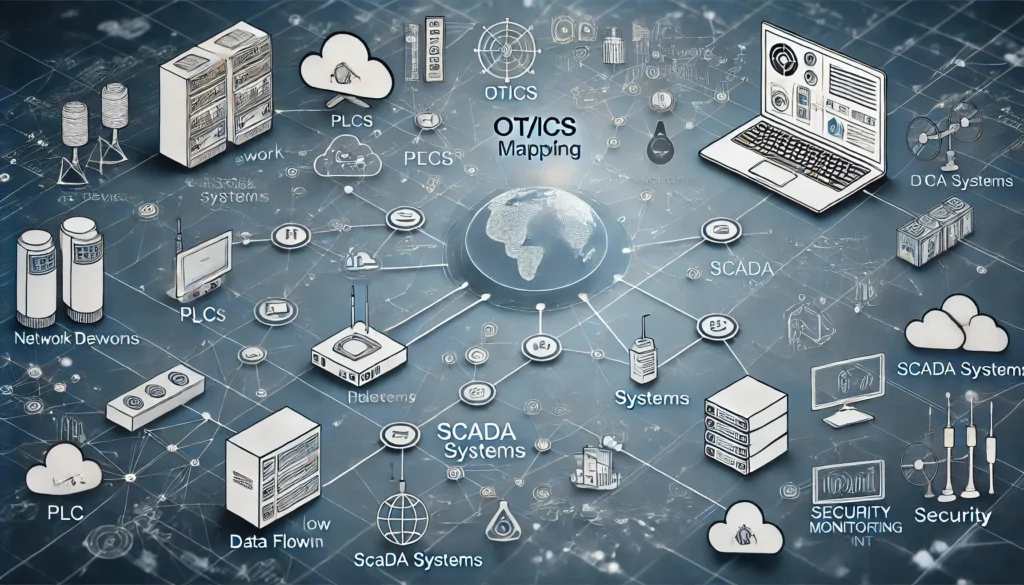
This phase involves diagnosing the client’s current security posture and identifying areas for improvement through detailed technical analysis.
- Asset Identification
- OT Network Mapping: Identify all devices and systems connected to the network to fully understand its structure.
- Analyzing Data Flow: Evaluate how data moves within OT systems and identify potential vulnerabilities.
- Security Vulnerability Assessment
- Network Structure Evaluation: Assess flat network designs where lack of segmentation exposes OT systems to attacks.
- Device Configuration Review: Identify legacy system misconfigurations, use of default passwords, and outdated software.
- Account Management: Ensure adherence to the principle of least privilege.
- Threat Modeling
- Identifying Attack Vectors: Analyze OT-specific threats like physical access, insider threats, and external attacks.
- Scenario-Based Testing: Simulate major threat scenarios, such as ransomware or DoS attacks, to evaluate vulnerabilities.
3. Security Design and Recommendations

Using the findings from the preliminary assessment, security frameworks are designed, and improvement measures are proposed.
- Network Segmentation Design
- Zone and Conduit Framework: Protect critical assets through network segmentation to prevent threat propagation.
- DMZ Design: Strengthen access control between IT and OT networks.
- Recommending Security Equipment
- Propose OT-appropriate tools like firewalls, intrusion detection/prevention systems (IDS/IPS), VPNs, and secure gateways.
- Patch Management and Backup Design
- Suggest virtual patching or separate test environments to address challenges with legacy systems.
- Establishing Security Monitoring Systems
- Recommend leveraging a SOC (Security Operation Center) for real-time threat detection and response.
4. Implementation and Validation of Solutions

This phase involves deploying and validating the proposed security solutions.
- Deploying Security Solutions
- Install and configure security solutions compatible with OT devices.
- Penetration Testing and Simulation
- Conduct penetration testing based on major threat scenarios to validate the effectiveness of security measures.
- OT/IT Integration Testing
- Ensure consistent security across IT and OT systems by testing their interaction and interoperability.
5. Training and Continuous Management

To maintain and enhance the established security framework, ongoing education and management activities are essential.
- Providing Training Programs
- Conduct security awareness and incident response training for OT operators and IT administrators.
- Periodic Audits and Reporting
- Perform regular security checks and share detailed reports with clients on security performance.
- Threat Detection and Incident Support
- Monitor abnormal activities in real-time and support rapid recovery during incidents.
Conclusion
OT/ICS security consultants play a crucial role in protecting client operations, preventing business disruptions caused by security incidents, and achieving regulatory compliance and industry standards. Their systematic and step-by-step approach focuses on understanding the unique characteristics of OT environments and providing tailored solutions to meet client needs. OT security transcends mere technical implementation and serves as a critical component for ensuring the stability and sustainability of industrial operations.

![[OT Sec] “A Single Cyberattack Could Cause Billions in Damages?! UR E26-Based Ship Cybersecurity Checklist Revealed!”](https://ota2z.com/wp-content/uploads/2025/03/DALL·E_2025-03-09_19.15.10_-_A_digital_illustration_of_maritime_cybersecurit-768x439.webp)
![[OT보안] “산업 자동화 제어시스템(IACS) 사이버보안 완전 가이드: ISA 62443 표준 기반 실무 접근법”](https://ota2z.com/wp-content/uploads/2025/08/ChatGPT-Image-2025년-8월-13일-오전-10_16_37-768x768.webp)

![[물리보안] “물리적 접근 통제 및 인증 시스템 완전 가이드 – PSP 실무자를 위한 종합 설계 매뉴얼”](https://ota2z.com/wp-content/uploads/2025/10/ChatGPT-Image-2025년-8월-5일-오후-01_48_47-768x768.webp)
![[OT보안] “산업제어시스템 사이버보안 표준의 글로벌 융합 전략: ISA/IEC 62443과 NIST CSF 통합 활용 가이드”](https://ota2z.com/wp-content/uploads/2025/08/ChatGPT-Image-2025년-8월-13일-오후-05_38_15-768x768.webp)