[Security Bi-Weekly #02] ‘$6.3 Billion in 20 Minutes: 5 Signs Attackers Now Move at Machine Speed’


Defend: Detect threats faster and contain their spread.
Thwart: Prepare early for risks that will grow over time.
* The Secure, Defend, and Thwart lenses come from the NIST Cyber AI Profile (NISTIR 8596), which extends the NIST Cybersecurity Framework (CSF) 2.0 to AI environments. This newsletter applies the same three lenses across all security domains, not only AI.
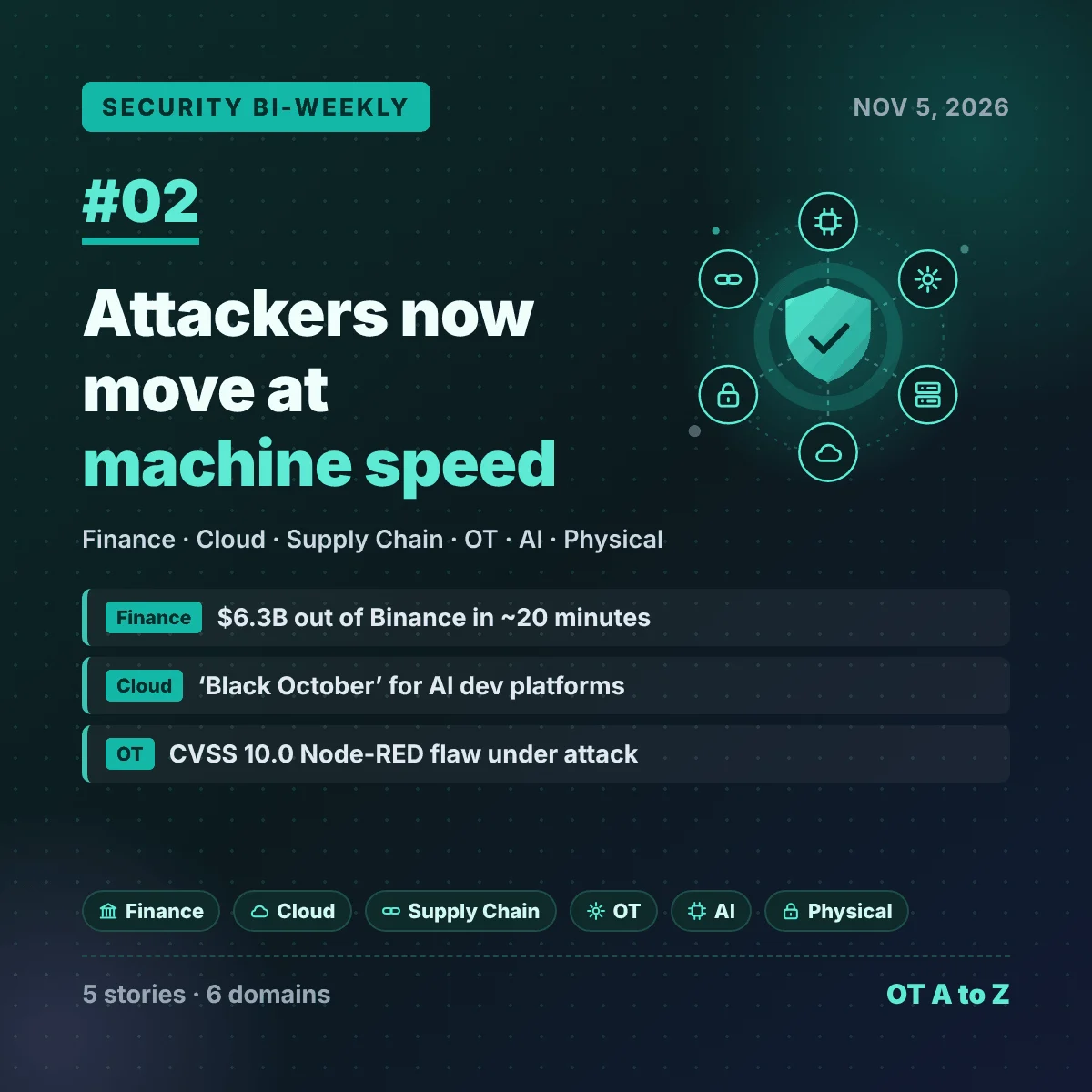
- [Finance · Identity] ‘A DevOps laptop, a service container, and a reported $6.3 billion gone from Binance’
- [Cloud · Supply Chain] ‘”Black October” for AI developer platforms: stored secrets became stolen AI bills’
- [OT Security] ‘CVSS 10.0 and under active exploitation: Node-RED on Siemens SIMATIC IoT2050’
- [AI · OT] ‘Frontier AI can draft workable OT attack plans, but not reliably yet’
- [Physical Security] ‘Two nights, no operators found: drones close Jersey Airport as airport drone incidents pass 330 this year’
This Issue’s Perspective
The five stories in this issue share a common unit of measure: time. Roughly $6.3 billion reportedly left Binance wallets in about 20 minutes. Attackers moved through at least nine AI developer platforms in a single month, turning stored secrets into other people’s AI bills. A CVSS 10.0 flaw in an industrial edge device was being mass-scanned and exploited on internet-exposed devices. Frontier AI models produced workable OT attack plans on about 90% of first attempts. And a few drones were enough to close an airport two nights in a row.
Most of our controls still assume a human pace: a change ticket, a weekly review, a quarterly patch window, a guard who notices. For leaders, the question this issue raises is simple. Where does our response still depend on someone noticing in time, and what would happen if they did not?
Top Security Stories
1. [Finance · Identity] ‘A DevOps laptop, a service container, and a reported $6.3 billion gone from Binance’
What happened
In late October 2026, Binance suffered what analysts describe as the largest crypto theft on record. Blockchain analytics firm TRM Labs estimates about $6.36 billion left Binance wallets across ten blockchains, mostly within roughly 20 minutes. These figures are still developing estimates. Binance said its initial investigation points to a compromised laptop belonging to a DevOps engineer, which may have been used to reach a service container and submit unauthorized withdrawal transactions. Binance said it found no evidence of a wallet private key leak.
Co-CEO Richard Teng told BleepingComputer the attacker did not simply use one engineer’s permissions, and that investigators found additional breach points. TRM Labs and Chainalysis linked the theft to TraderTraitor, a North Korea-linked group, although Binance has not confirmed the attribution. Binance says about $3 billion has been frozen on-chain, that it will cover all losses, and that Binance.US was not affected.
Why it matters
The private keys reportedly stayed safe, yet the money still moved. That is the lesson. When an engineer’s endpoint can reach a production service that is able to initiate withdrawals, the keys are only as safe as the weakest workstation with a path to the signer. Twenty minutes is also shorter than most approval chains, on-call escalations, or fraud reviews. Any organization that moves value, whether money, inventory, or control commands, should ask what an attacker could do with one engineer’s laptop before anyone noticed.
- DevOps engineer: An engineer who builds and runs the tools that deploy and operate software in production, and who therefore often has broad system access.
- Service container: A packaged, isolated piece of software that runs one function, such as processing withdrawals, inside a larger platform.
- Private key: The secret that proves ownership of a crypto wallet and authorizes spending from it. Whoever controls it, or a system that can use it, can move the funds.
- Attribution: Identifying who is behind an attack. Attribution by analysts is an assessment, not a legal or official finding.
- Velocity limit: A rule that caps how much value can move in a short period, so that a fast attack is slowed down automatically.
- Tabletop exercise: A structured walkthrough of an incident scenario in which teams practice decisions without touching live systems.
2. [Cloud · Supply Chain] ‘”Black October” for AI developer platforms: stored secrets became stolen AI bills’
What happened
Cloud platform Railway detected an attempted privilege escalation in its build infrastructure on October 20, 2026. According to Railway’s preliminary report, the attacker reached CI credentials, queried encrypted environment variables, and decrypted a subset. Railway put the potentially affected group at no more than 1.85% of workspaces, invalidated tokens, and moved builders to single-tenant environments. It said it believes the incident is part of a series of attacks on platform companies aimed at compromising AI inference providers.
Ten days later, on October 30, Northflank disclosed its own incident after an alert from cloud security firm Wiz, telling customers to assume their environment variables had been decrypted and to rotate every secret. Customers then reported unauthorized use of AI API keys stored on the platform. Wiz’s “Black October” report counted at least nine incidents at AI developer platforms during the month, including Railway, Northflank, OpenCode, Warp, and Lightning AI, without confirming a single attacker. In two cases Wiz investigated, stolen enterprise credentials drove about 2.5 million Amazon Bedrock API calls and roughly $100,000 in usage.
Why it matters
Platform-as-a-service tools are now part of the software supply chain, and the environment variables they store are often the keys to everything else: databases, cloud accounts, payment systems, and AI services. AI API keys have become a direct revenue target because they can be resold or used to run workloads at the victim’s expense, a practice called LLMjacking. The blast radius of one platform breach is therefore not one application. It is every downstream service whose credentials sat in that platform, and the bill can arrive before the alert does.
- PaaS (Platform as a Service): A cloud service that builds, deploys, and runs a customer’s applications so the customer does not manage the servers.
- Environment variable: A setting passed to an application at runtime, commonly used to store passwords, API keys, and connection strings.
- CI/CD: Continuous integration and continuous delivery: the automated pipeline that builds, tests, and deploys code.
- Privilege escalation: When an attacker turns limited access into higher-level access, such as admin rights.
- LLMjacking: Using stolen credentials to run large language model (LLM) workloads at someone else’s expense, or reselling that access.
- Secret rotation: Replacing passwords and keys with new ones so that any stolen copies stop working.
3. [OT Security] ‘CVSS 10.0 and under active exploitation: Node-RED on Siemens SIMATIC IoT2050’
What happened
A missing-authentication flaw, CVE-2026-58115, affects Siemens SIMATIC IoT2050 Advanced devices running Industrial OS with Node-RED installed, in all versions before V4.3.4.1. It carries the maximum CVSS score of 10.0 under both v3.1 and v4.0. Siemens (SSA-834709) and CISA (ICSA-26-237-03) have published advisories, and the fix is Industrial OS V4.3.4.1 or later.
Public reporting summarized by 1898 & Co. on November 4 says attackers have been exploiting the flaw since at least October 30, using mass scanning to find internet-reachable devices. One reported method wires a Node-RED inject node to an exec node to download a Linux bot binary into memory and run it, and additional payloads and web shells have been observed. The activity is described as opportunistic rather than targeted.
Why it matters
Industrial edge gateways like the IoT2050 sit exactly where IT meets OT, often with a foot in both networks. A flaw that needs no credentials and is already being scanned for at internet scale turns any exposed device into a beachhead next to production systems. Opportunistic attackers are not choosing their victims; they are choosing their exposure. Plants that installed a gateway for a data project and left its web interface reachable may not even list it as an OT asset.
- Node-RED: An open-source, browser-based tool for wiring together devices and data flows, widely used on industrial gateways.
- Industrial edge device: A small computer at the edge of a plant network that collects machine data and passes it to IT or cloud systems.
- Missing authentication: A flaw where a function that should require login can be used by anyone who can reach it.
- Mass scanning: Automated probing of large parts of the internet to find devices with a specific weakness.
- Web shell: A malicious script left on a server that lets an attacker run commands remotely through a web interface.
- Network segmentation: Dividing a network into zones with controlled connections, so that a compromise in one zone cannot easily spread.
4. [AI · OT] ‘Frontier AI can draft workable OT attack plans, but not reliably yet’
What happened
OT security company Frenos published research on October 21, 2026, based on 16,980 tests run between October 2025 and September 2026 across ten AI models: six frontier models, two US open-weight models, and two foreign open-weight models, none of them named. Each model received background information, network and asset details, known weaknesses, and a set of possible attack actions, and was scored on whether its choices matched the required outcome.
The three strongest frontier models produced a workable attack plan about 90% of the time on the first attempt. However, only 60%, 62.9%, and 74.3% of their plans held up across every repeat. Single-action accuracy ranged from 6% to 47% depending on the model, and the best open-weight model, a non-US model, outscored three US frontier models overall. Frenos noted that no humans corrected the plans, that its test harness was simple, and that models still made mistakes, such as assuming access a plan had not established.
Why it matters
The barrier to planning an attack on industrial systems has been specialist knowledge of plants, protocols, and safety systems. This research suggests AI can now shorten that learning curve, even if it cannot replace an experienced operator. The inconsistency is a comfort today, but a skilled attacker can spot a model’s gaps and ask for revisions, which the study did not test. For defenders, the practical meaning is that the pool of people able to produce a credible OT attack plan is likely to grow faster than OT security teams can grow.
- Frontier model: One of the most capable, general-purpose AI models available at a given time, usually from a major AI lab.
- Open-weight model: An AI model whose trained parameters are published, so anyone can download, run, and modify it.
- Test harness: The software setup that feeds tasks to a model and checks its answers; a more capable harness can make a model perform better.
- Hallucination: When an AI model states something false or skips a step with confidence, as if it were correct.
- Threat model: A structured view of who might attack a system, how, and what they could achieve, used to decide which defenses matter most.
5. [Physical Security] ‘Two nights, no operators found: drones close Jersey Airport as airport drone incidents pass 330 this year’
What happened
Flights to Jersey Airport were disrupted on the evenings of October 30 and 31, 2026, after reports of drone activity nearby. On the first night, three inbound flights from the UK were diverted back. On the second, a charter from Madeira was diverted to Paris Charles de Gaulle, other flights faced long delays or cancellation, and the runway was reportedly closed until 10 pm. Police have not identified any operators, and it remains unclear exactly what was seen. Jersey’s Chief Minister described the incidents as deliberate and unlawful drone operations, and the government said it was working with UK authorities on detection and counter-drone support.
The disruption fits a wider pattern. Speaking in Frankfurt in late October, Munich Airport’s head of security operations reported more than 330 drone incidents near airports in 2026 so far. Drone alerts in early October forced temporary closures at Munich that stranded more than 10,000 passengers, and he noted that radio-frequency (RF) sensors are becoming less effective against more powerful and more autonomous drones.
Why it matters
Drone incidents show how physical security fails without a single fence being cut. A low-cost device, an uncertain sighting, and the need to err on the side of safety are enough to halt operations, and the cost lands on airlines, cargo, and passengers rather than on the attacker. The same logic applies to data centers, substations, and plants, where a drone can conduct surveillance or create a stop decision. Detection that relies on one sensor type and response plans that only have “shut down” as an option will keep turning uncertainty into outages.
- Counter-drone (C-UAS): Systems and procedures for detecting, tracking, identifying, and, where legal, stopping unauthorized drones.
- RF sensor: A detector that listens for the radio signals between a drone and its controller; it can miss drones that fly autonomously or use unusual links.
- Diversion: When a flight lands at a different airport from the one it was headed to, usually for safety reasons.
- Response ladder: A predefined set of escalating actions, each with a trigger and an owner, used instead of a single all-or-nothing decision.
- Critical infrastructure: Facilities and systems, such as airports, power, and water, whose disruption would seriously affect society or the economy.
Bi-Weekly Summary
This issue in one line: attacks now move at machine speed, while many defenses still move at meeting speed.
- Binance’s reported $6.3 billion loss shows that one compromised engineer endpoint can open a path to production withdrawals.
- A wave of breaches at AI developer platforms turned stored environment variables into stolen AI API keys and surprise bills.
- A CVSS 10.0 flaw in Siemens SIMATIC IoT2050 Node-RED is under active, opportunistic exploitation.
- Frenos found frontier AI models can draft workable OT attack plans, but still need human correction.
- Drone disruptions at Jersey and Munich show that physical detection gaps now close airports.
Share it with a colleague who owns security, infrastructure, or risk decisions. The next issue will be published in two weeks.
Further Reading
- Malwarebytes – Binance hit by largest-ever crypto theft, with $6.3 billion stolen
- BleepingComputer – Northflank security breach leads to abuse of customers’ AI API keys
- Brandefense – Railway cloud platform security incident (October 2026)
- 1898 & Co. – Missing authentication in Node-RED on Siemens SIMATIC IoT2050 exploited
- The Register – Frenos study on AI-assisted OT attack planning
- Dronewatch Europe – Alleged drone sightings cause two nights of disruption at Jersey Airport
- CargoForwarder Global – Drones pose a growing threat to civil aviation


