[OT Sec] 🛠 MODBUS: The Core Communication Language of OT Systems – From Structure to Security


Table of Contents
MODBUS, one of the most widely used communication protocols in Industrial Control Systems (ICS), has become a core communication language in smart factories, water treatment facilities, power plants, and more. Its simplicity and versatility have made it a global standard. However, in today’s era of increasing OT security concerns, MODBUS is also known for its lack of built-in security features.
This article comprehensively covers the structure of MODBUS, the difference between RTU and TCP, and how to address related security risks using the ISA/IEC 62443 security framework.
1. What is MODBUS?

MODBUS is an industrial automation communication protocol developed by Modicon (now Schneider Electric) in 1979. As an open protocol, it can be freely implemented and is commonly used for data exchange between PLCs, sensors, HMIs, and SCADA systems.
- Communication Structure: Master-Slave model (1 master controls multiple slaves)
- Data Units: Coil, Discrete Input, Input Register, Holding Register
- Transmission Modes: RTU, ASCII, and TCP/IP
2. MODBUS RTU vs. TCP/IP: Structural and Security Comparison
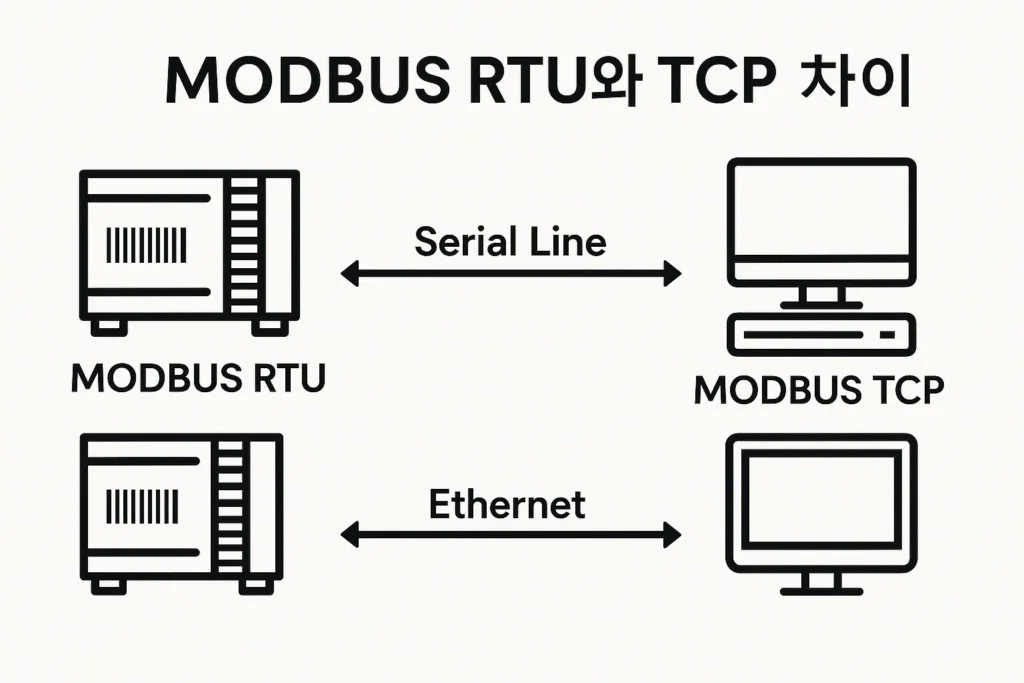
| Category | MODBUS RTU | MODBUS TCP |
|---|---|---|
| Communication | Serial (RS-232/485) | Ethernet-based (TCP/IP) |
| Data Format | Binary (compact) | TCP/IP packet structure |
| Security Controls | Virtually none | Can apply firewalls, ACLs |
| Speed | Slower | Faster |
| Network Scope | Limited, isolated networks | Wide area, Internet-enabled |
Threat Factors from a Security Perspective
| Threat Type | MODBUS RTU | MODBUS TCP |
|---|---|---|
| Lack of Authentication | No user authentication | IP-based, no additional auth |
| Data Tampering | CRC check but can be bypassed | Vulnerable via TCP retransmission |
| Access Control | Easily bypassed if physically accessed | Open port 502 allows anyone |
| Spoofing | Slave address spoofing | IP/session spoofing possible |
3. Security Mitigation via ISA/IEC 62443 Framework
ISA/IEC 62443 is an international cybersecurity standard for industrial automation systems, covering asset identification, threat analysis, requirement mapping, secure design, and maintenance.
| Requirement ID | Description | MODBUS Mitigation Strategy |
|---|---|---|
| SR 1.1 | Prevent unauthorized access | Use authentication gateways or firewalls |
| SR 2.1 | User authentication & access control | Integrate with external authentication |
| SR 3.1 | Data integrity protection | Encrypt or tunnel communications (e.g., VPN) |
| SR 4.1 | Confidentiality assurance | VLAN segregation, DPI-based firewalls |
| SR 5.2 | Network boundary protection | Port 502 filtering, ACL configurations |
| SR 7.1 / 7.6 | Event detection / logging | Deploy OT IDS/IPS and protocol analyzers |
Real-World Examples
MODBUS TCP Environment
- Limit access to port 502, configure ACLs
- Deploy DPI-enabled OT security appliances
MODBUS RTU Environment
- Lock serial ports and log signals
- Strengthen authentication on serial-to-Ethernet gateways
4. Summary: How Should We Approach MODBUS Security?
MODBUS remains a highly prevalent protocol in industrial environments. However, its lack of native security functions is a critical vulnerability. When ICS assets are connected to external networks or enabled for remote control, it’s essential to design and implement security controls based on the ISA/IEC 62443 framework.
✅ Any asset using MODBUS should be treated as a security target.
✅ Use ISA/IEC 62443 to determine the required Security Level (SL-C) and implement corresponding controls.
✅ Even in air-gapped environments, prepare for potential physical intrusions.
![[OT보안] 글로벌 OT 사이버보안 제도 패러다임 변화와 한국 지역특화산업 연계전략](https://ota2z.com/wp-content/uploads/2025/08/ChatGPT-Image-2025년-8월-1일-오후-03_13_51-768x768.webp)
![[OT 보안] “산업제어시스템 프로토콜 보안: Modbus와 OPC 실무자 완전 가이드”](https://ota2z.com/wp-content/uploads/2025/08/ChatGPT-Image-2025년-8월-14일-오전-11_23_17-768x768.webp)
![[OT Sec] “Industrial Control Systems Cybersecurity: Complete Cyber-PHA Guide”](https://ota2z.com/wp-content/uploads/2025/08/ChatGPT-Image-2025년-8월-12일-오전-11_35_59-768x768.webp)
![[OT보안] “OT 제어시스템 I/O 리스트 보안 관리 가이드: 내부자 위협 대응을 위한 실무 매뉴얼”](https://ota2z.com/wp-content/uploads/2025/07/ChatGPT-Image-2025년-7월-16일-오후-01_06_28-768x768.webp)
![[Physical Sec] “Comprehensive CPTED-Based Physical Security Design Guide”](https://ota2z.com/wp-content/uploads/2025/08/ChatGPT-Image-2025년-8월-4일-오전-11_14_39-768x768.webp)
