[OT Sec] Why Network Segmentation (5 Steps) Between OT and IT Is Essential


Table of Contents
Key Strategies and Practical Guidelines for OT Security
Why Is OT Security Urgently Needed?

There was a time when Operational Technology (OT) and Information Technology (IT) existed in entirely separate spheres. Control systems, monitoring equipment, and automation hardware within factories operated in isolation, disconnected from the outside world. However, with the rapid adoption of smart factories, Industrial IoT (IIoT), and cloud-based production management, the boundary between OT and IT has become increasingly blurred — creating a structure that is now more vulnerable to cyber threats.
In recent years, ransomware attacks and malware targeting Industrial Control Systems (ICS) have significantly increased. One of the first lines of defense to collapse in these scenarios is the boundary between OT and IT networks — namely, network segmentation.
What Is Network Segmentation and Why Does It Matter?

Network segmentation refers to dividing networks to prevent threats from one environment (typically IT) from spreading to another (OT). There are two main approaches:
- Physical Segmentation: Complete separation via independent cables, switches, and routers
- Logical Segmentation: Segregation using VLANs, firewalls, and access control within shared infrastructure
Network segmentation plays several vital roles in OT environments:
- Attack Containment: Prevents threats from spreading from IT systems to OT systems
- Operational Stability: Maintains the availability and real-time performance of control systems
- Compliance Readiness: Helps meet regulatory and audit requirements (e.g., NIST, ISA/IEC 62443)
In short, segmentation is not merely a security tool — it’s a risk management strategy critical to operational safety and continuity.
Step-by-Step: How to Implement OT/IT Network Segmentation
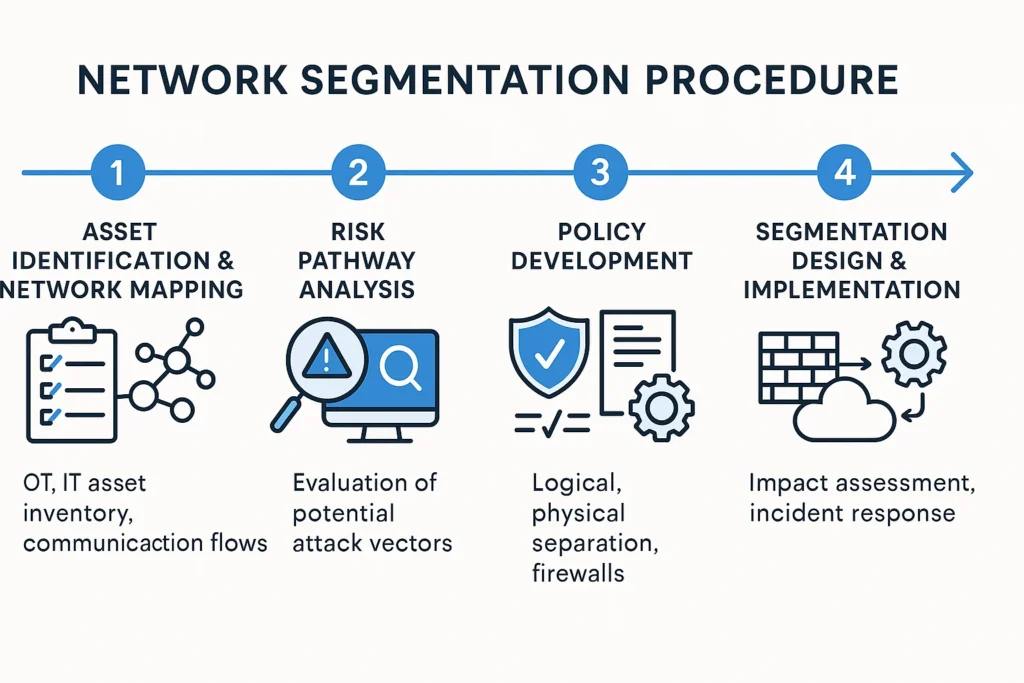
Segmentation isn’t about unplugging cables. It requires a structured, strategic approach:
1. Asset Identification & Network Mapping
- Create an inventory of OT and IT assets
- Analyze communication flows (e.g., PLC ↔ SCADA ↔ MES)
2. Risk Pathway Analysis
- Identify potential attack vectors
- Assess remote access points and maintenance connections
3. Policy Development
- Define access control policies (e.g., whitelist-only communication)
- Restrict certain protocols (e.g., block FTP, SMB)
4. Segmentation Design & Implementation
- Logical: Configure VLANs, ACLs, firewalls
- Physical: Deploy separate switches, firewalls, data diodes
- Use mediation servers for secure inter-network data exchange
5. Testing & Operational Planning
- Evaluate the impact of segmentation on OT system performance
- Define incident response and contingency measures
Real-World Challenges to Consider

While theoretically ideal, segmentation in practice must overcome several hurdles:
🔧 Operational Availability Risks
- Potential disruptions in real-time monitoring
- Delayed updates and maintenance tasks
🔍 Remote Maintenance Needs
- External vendors often require access
- Secure tunnels or mediation zones are necessary
🧩 Legacy System Compatibility
- Older PLCs or HMIs may not support modern security tools
- Upgrading may be costly and logistically complex
💸 Cost and Staffing Burden
- Shortage of skilled security personnel
- High initial investment in infrastructure and policy implementation
Physical vs Logical Segmentation: How to Choose?
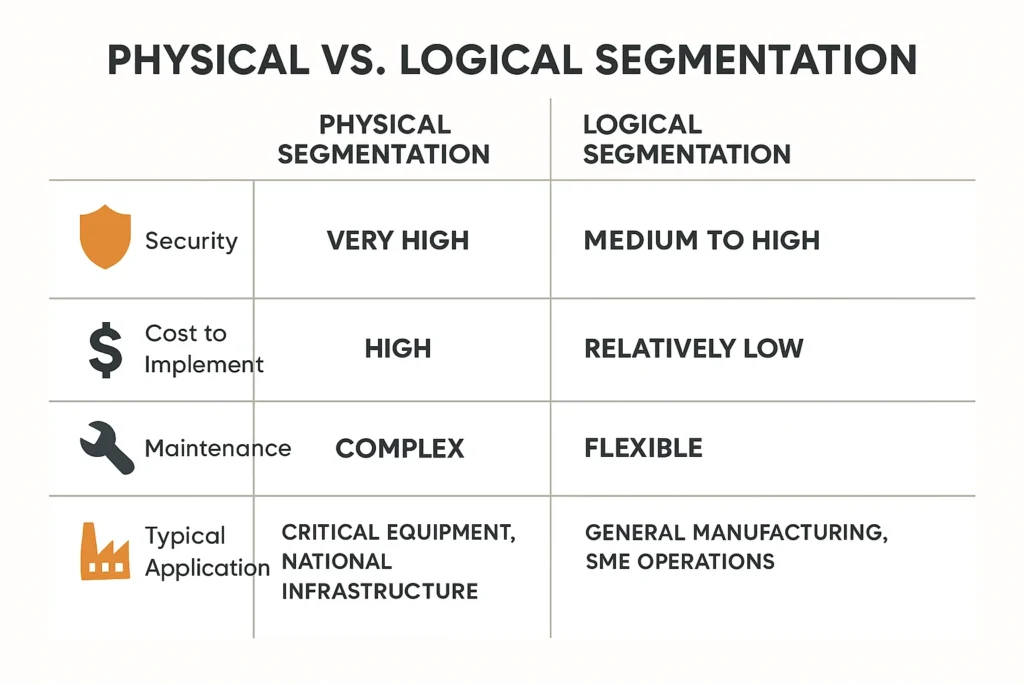
| Criteria | Physical Segmentation | Logical Segmentation |
|---|---|---|
| Security | Very High | Medium to High |
| Implementation Cost | High | Relatively Low |
| Maintenance | Complex | Flexible |
| Typical Use | Critical systems, national infra | General manufacturing, SMEs |
Key consideration: What are you protecting?
If it’s critical national infrastructure or a core production line, physical segmentation is appropriate. For SMEs with limited budgets, logical segmentation can offer effective protection with more flexibility.
Best Practices for Successful Segmentation
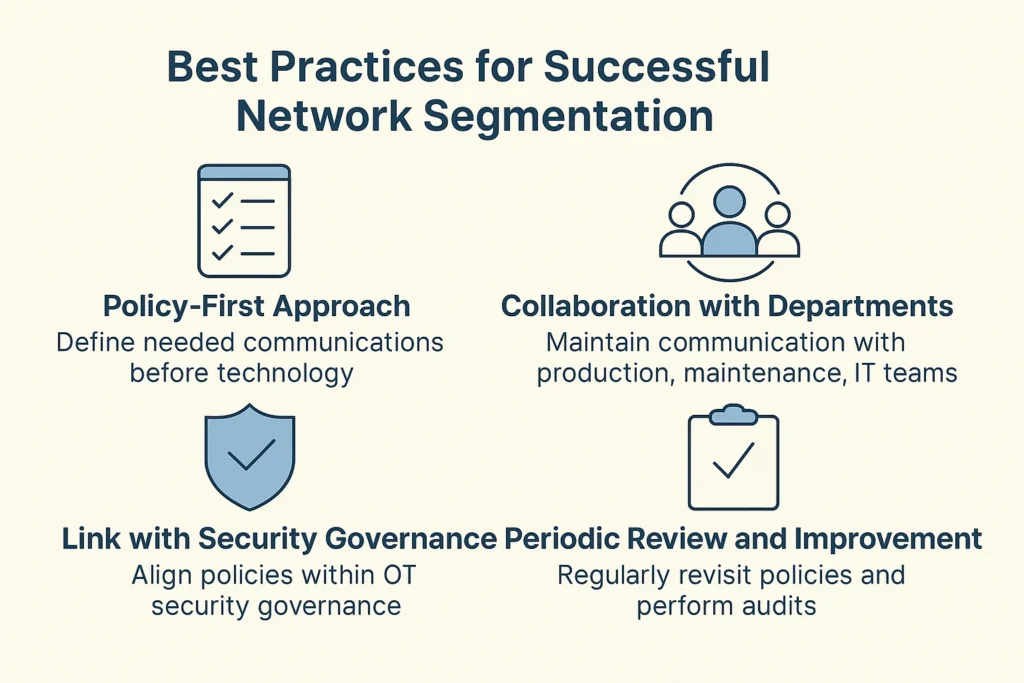
- Policy-First Approach
Define essential communications before implementing technologies. - Cross-Departmental Collaboration
Engage production, maintenance, and IT teams consistently. - Align with Security Governance
Ensure policies fit within broader OT security frameworks. - Ongoing Review and Optimization
Regularly reassess policies, perform audits, and train staff
Conclusion: Network Segmentation Is No Longer Optional

In OT environments, segmentation is not just a cybersecurity measure — it is foundational infrastructure for stable industrial operations. Instead of striving for total isolation, organizations should focus on achievable, practical segmentation that balances business continuity with protection.
And remember: post-implementation is when the real work begins. Continuous monitoring, auditing, and workforce training are essential to keep your segmentation efforts effective and alive.
Suggested External Links:


![[OT Sec] ISA/IEC 62443 Certification Program: A Global Standard and Training Program for Industrial Cybersecurity Experts](https://ota2z.com/wp-content/uploads/2025/01/DALL·E_2025-01-13_15.30.49_-_A_secure_industrial_control_environment_showcas-768x439.webp)


![[Physical Sec] “Complete PSP Certification Mastery Guide: Your Definitive Roadmap to Becoming a Physical Security Professional”](https://ota2z.com/wp-content/uploads/2025/08/ChatGPT-Image-2025년-8월-5일-오후-08_15_37-768x768.webp)