[AI Data Center Security] “Security Control Prioritization in AI Infrastructure: 4 Steps to Spend a Limited Budget With AHP”


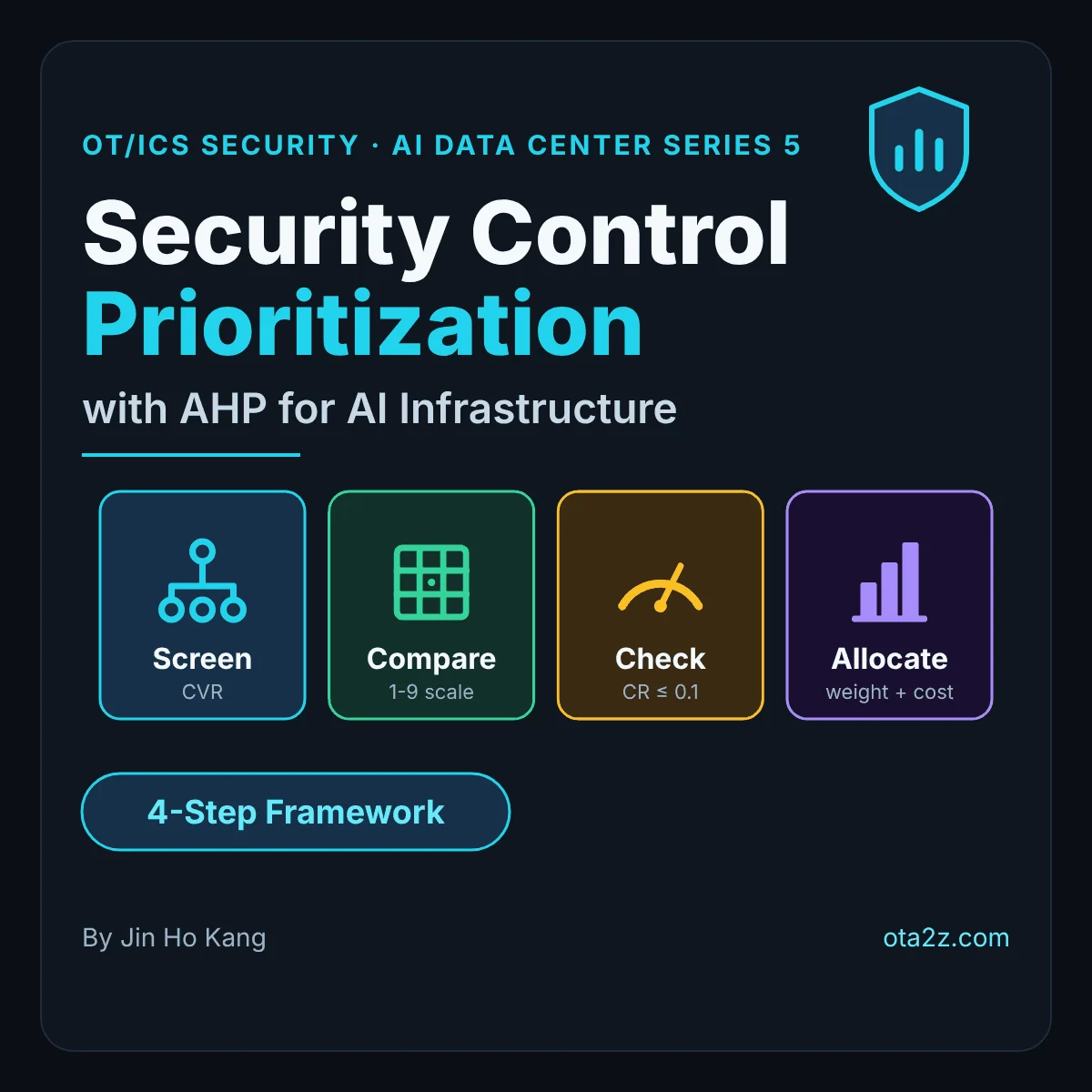
Security Control Prioritization in AI Infrastructure: 4 Steps to Spend a Limited Budget With AHP
By Jin Ho Kang · OT/ICS Security Consultant
Table of Contents
- Why Security Control Prioritization Is a Budget Problem First
- Pairwise Comparison: How AHP Turns Judgment Into Weights
- From CVR and CR ≤ 0.1 to a Security Control Prioritization Framework
- A Worked Example: Security Control Prioritization for a GPU Cluster
- Where Security Control Prioritization With AHP Needs Judgment
- Bringing It Together
- References
Most security budgets are not set by a risk model. They are set by whoever argues loudest in the planning meeting, or by last quarter’s incident. For an AI infrastructure operator, where the assets at stake are large and the budget is still finite, that habit is expensive. Security control prioritization is the discipline of replacing the loudest voice with a transparent, repeatable ranking. This piece shows how I translate the Analytic Hierarchy Process (AHP), the pairwise comparison method used in my doctoral research on OT security control items, into a practical framework for one question: where should an AI infrastructure operator invest first? The worked example is illustrative and labeled as such, because the method, not the numbers, is what carries over to your own environment, and security control prioritization only works when the judgments behind it are your own.
Why Security Control Prioritization Is a Budget Problem First
The cost of getting the order wrong is visible in public data. IBM’s 2025 Cost of a Data Breach study puts the global average breach at $4.44 million, and it reports that 13% of organizations had a breach of AI models or applications, with 97% of those lacking proper AI access controls (IBM, 2025). The same study found that one in five organizations reported a breach linked to shadow AI, that only 37% have policies to manage AI or detect shadow AI, and that high levels of shadow AI added an average of $670,000 to breach costs (IBM, 2025). These figures cover AI models and applications broadly, not compute infrastructure specifically, so I read them as a pattern rather than a measurement of data center risk: the controls were not exotic, they were simply not first in line for funding. That is a security control prioritization failure rather than a knowledge failure, and it is the failure a structured ranking method is designed to prevent by forcing the trade-offs into the open before money is spent.
Fig. 1 – Four figures that show why security control prioritization matters (IBM, 2025)
※ Key terms
Security control – A safeguard, technical or procedural, that reduces the likelihood or impact of a security event.
Security control prioritization – Ranking candidate controls so that a limited budget funds the most important ones first.
Shadow AI – AI tools or services used without the organization’s approval or oversight.
AI access controls – Mechanisms that limit who or what may use AI models, data, and applications.
Pairwise Comparison: How AHP Turns Judgment Into Weights
AHP, developed by Thomas Saaty, breaks a decision into a goal and a set of alternatives, then asks experts one narrow question at a time: how much more important is control A than control B for this goal? Answers use Saaty’s fundamental scale from 1 (equal) through 3 (moderate), 5 (strong), and 7 (very strong) to 9 (extreme), with even numbers for in-between judgments and reciprocals for the reverse comparison. The resulting matrix yields a priority vector, and a built-in test measures whether the judgments contradict one another: the consistency index CI is computed from the matrix’s largest eigenvalue, divided by a benchmark random index RI to give the consistency ratio CR, and Saaty’s rule is that a CR of 0.1 or less indicates acceptable consistency (Saaty, 2000, as documented by Esri). The reason this suits security control prioritization is practical: asking an expert to compare two controls is easier to answer and to defend than asking for an absolute score on dozens of controls, and the consistency check catches the contradictions that absolute scoring hides.
Fig. 2 – The 1-9 pairwise scale and the CR ≤ 0.1 gate used in security control prioritization
※ Key terms
AHP – Analytic Hierarchy Process: a decision method that derives weights from pairwise comparisons.
Pairwise comparison – Judging two alternatives against each other on one criterion at a time.
Priority vector – The set of weights, computed from the principal eigenvector, that ranks the alternatives.
Consistency ratio (CR) – CI divided by RI; measures how contradictory the pairwise judgments are, with 0.1 or less treated as acceptable.
From CVR and CR ≤ 0.1 to a Security Control Prioritization Framework
In my doctoral research I paired AHP with Lawshe’s content validity ratio (CVR). CVR asks a panel to rate each candidate item as essential, useful but not essential, or not necessary; a positive value means at least half of the experts rated the item essential, and the minimum acceptable value depends on panel size, for example 0.62 for ten panelists and 0.42 for twenty (Wikipedia, “Content validity”). The research behind my work (N=100) found that IT-centric controls were negatively associated with availability in OT environments, which is why I organized 39 controls into a 13-item framework instead of ranking a generic IT list. The translation into practice is simple: use CVR to decide which controls deserve a place on the candidate list, use pairwise comparison to rank them, and use the CR gate to decide whether the ranking can be trusted. In security control prioritization, a CR above 0.1 is not a failure; it is a prompt to revisit the comparisons. Those two checks are what separate security control prioritization from a loud meeting, and they travel unchanged from a dissertation to an investment committee.
Fig. 3 – A four-step security control prioritization pipeline from CVR screening to budget allocation
※ Key terms
CVR – Content validity ratio: Lawshe’s measure of how many panelists rate an item essential, from -1 to +1.
Panelist – An expert who rates items or makes pairwise judgments.
Gate – A pass-or-fail check a result must clear before it is used, such as CR at or below 0.1.
A Worked Example: Security Control Prioritization for a GPU Cluster
The following example is illustrative: the judgments are invented to show the arithmetic and are not research results. Take four candidate control groups for a GPU training cluster, each drawn from earlier articles in this series: network segmentation, maintenance access control, physical and environmental monitoring, and availability-first change control. An expert compares them pairwise: segmentation against maintenance access scores 2, against physical monitoring 3, and against change control 5; maintenance access against physical monitoring scores 3 and against change control 3; physical monitoring against change control scores 2. The resulting weights are about 47%, 30%, 14%, and 9%. The largest eigenvalue is 4.065, so CI is 0.022; with the standard random index of 0.90 for four items, CR is 0.024, well under 0.1, and the ranking is accepted. For security control prioritization the weights say which control matters most for the goal, and a budget owner can then divide each weight by cost to see which funding order buys the most priority per unit spent.
Fig. 4 – Illustrative security control prioritization result with the consistency check (worked example, not research data)
※ Key terms
Largest eigenvalue (λmax) – The principal eigenvalue of the comparison matrix; it equals n when judgments are perfectly consistent.
CI – Consistency index: (λmax – n) / (n – 1).
RI – Random index: Saaty’s benchmark CI for random matrices of a given size, 0.90 for n = 4.
Illustrative example – Invented numbers used to show the method, not findings from research.
Where Security Control Prioritization With AHP Needs Judgment
AHP is a way to structure judgment, not a substitute for it. The weights describe relative importance within the list you chose, so they say nothing about controls left off the list, and they are not a measure of absolute risk reduction. A high CR is caught by the gate, but consistent bias is not: five experts who share the same blind spot will produce a perfectly consistent and perfectly wrong ranking. The workload also grows quickly, because n items need n(n-1)/2 comparisons: 6 for four controls, 78 for thirteen, and 741 for thirty-nine, which is why grouping controls into a small framework matters. When several experts take part, their matrices are commonly aggregated with the geometric mean before the CR is checked, and a sensitivity test, which changes one judgment at a time to see whether the order flips, shows how fragile the ranking is. Treat security control prioritization as a disciplined conversation with numbers attached, and let threat data and cost sit beside the weights in the final decision.
※ Key terms
Aggregation – Combining several experts’ matrices into one, commonly with the geometric mean.
Sensitivity test – Changing one judgment at a time to see whether the final ranking changes.
Blind spot – A risk that all experts overlook, which consistency checks cannot detect.
Bringing It Together
The series started with segmentation, availability, physical risk, and control mapping, and it ends with the question every operator eventually faces: which of these first? Security control prioritization with AHP answers it with a method that carries academic safeguards, CVR for the candidate list and CR at or below 0.1 for the judgments, into a form a budget committee can read. That combination of research discipline and practitioner pragmatism is exactly what securing AI compute infrastructure needs, and it is the standard I try to hold my own work to.
References


