[OT Sec] Strategic Framework for Justifying OT Security Investment: A Deep-Dive Guide for Executive Persuasion


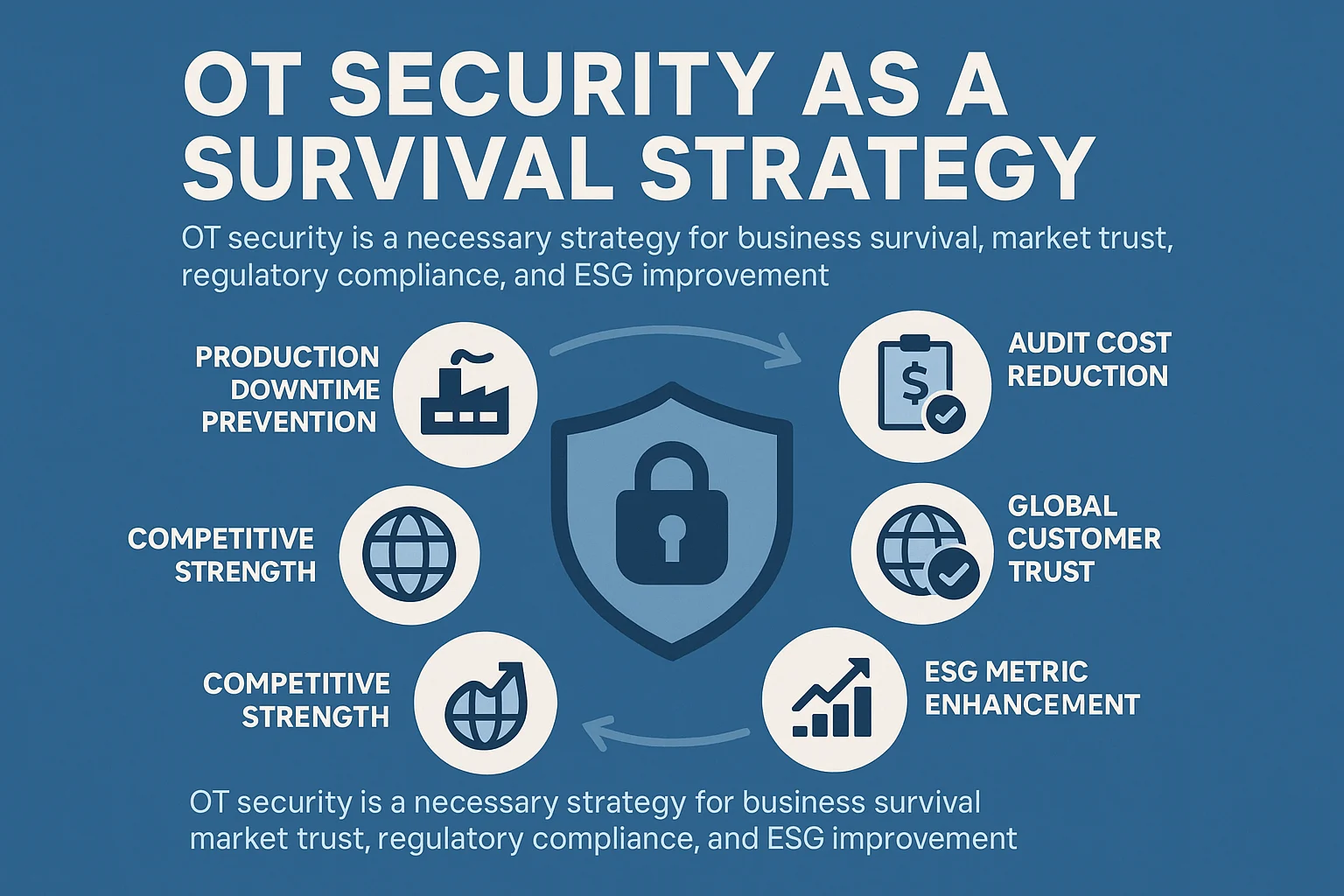
Table of Contents
1. Introduction: Why OT Security Is an “Opportunity,” Not a “Cost”
With the rapid acceleration of digital transformation across manufacturing, heavy industry, and semiconductor sectors, the boundary between Operational Technology (OT) and traditional Information Technology (IT) has significantly blurred.
Previously isolated OT systems operated in air-gapped environments but are now increasingly interconnected due to smart factory initiatives, remote maintenance requirements, and cloud integration demands.
While these changes have improved convenience and productivity, they have simultaneously exposed OT systems to structural vulnerabilities against external cyber threats.
Recent OT-focused cyber incidents, such as the Colonial Pipeline attack and the Triton malware incident, demonstrate that breaches can cause not only massive production disruptions but also financial loss, environmental damage, and even human casualties.
Despite this reality, many executives continue to regard OT security as merely a “technical expense” or an “IT department issue.”
This is a dangerous misconception. OT security is not just about preventing hacking – it is a strategic investment to protect a company’s productivity, safety, regulatory compliance, and market credibility.
- Minimizing production downtime risks prevents multi-billion-won losses.
- Compliance with tightened regulations, such as the Serious Accidents Punishment Act and the Personal Information Protection Act, mitigates legal liabilities.
- Earning and maintaining trust from global clients and investors strengthens long-term competitiveness.
Thus, convincing executives requires presenting clear metrics, real-world examples, and ROI-based justifications — not vague cybersecurity arguments.
This article analyzes the justification for OT security investment focusing on two key pillars: preventing production downtime and enhancing audit readiness.
2. The Economic Perspective of OT Security Investment: ROI (Return on Investment)
1) Preventing Production Downtime
Data and Evidence
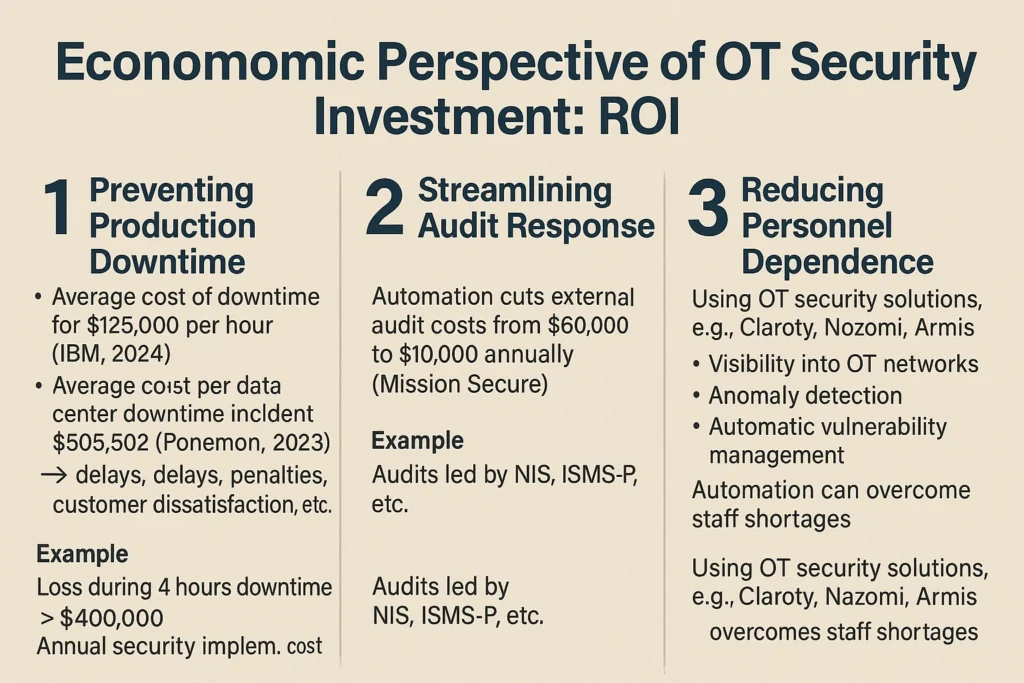
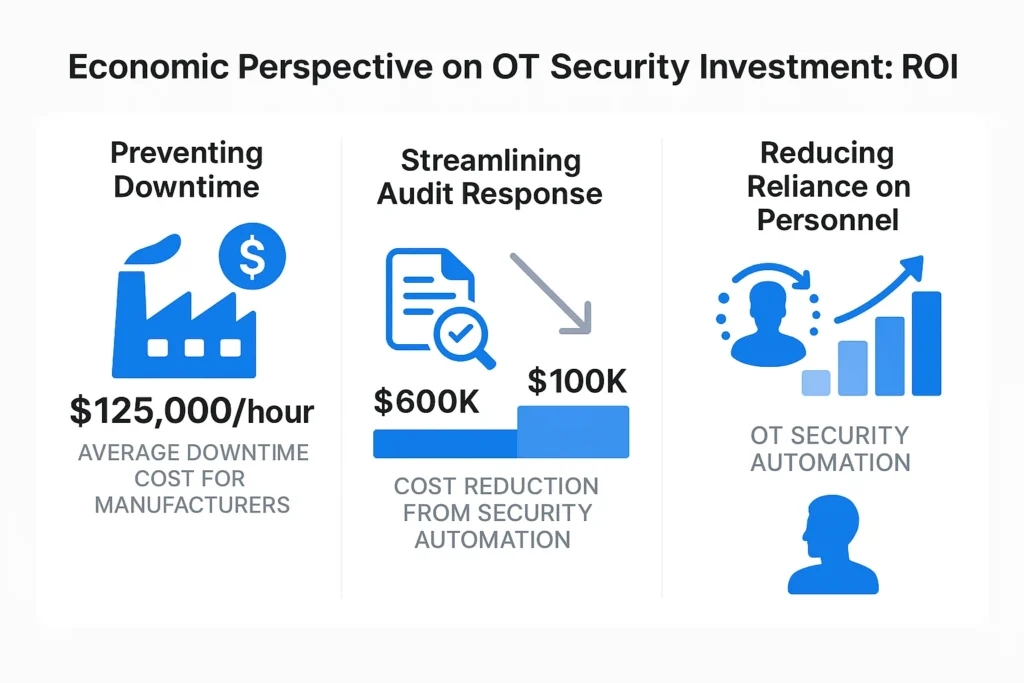
- The global manufacturing industry’s average downtime cost is approximately $125,000 per hour.
(Source: IBM Cost of a Data Breach Report 2024) - Data center outage costs are estimated at an average of $505,502 per incident.
(Source: Ponemon Institute – Cost of Data Center Outages)
Downtime does not only cause temporary production losses. It triggers cascading effects such as:
- Delivery delays,
- Contract penalties,
- Decline in customer trust,
- Decrease in future order volumes.
A single downtime event can significantly impact annual performance.
Example
- Estimated loss for 4 hours of downtime: Over 500 million KRW.
- Annual OT security system investment: Approximately 120 million KRW.
Thus, preventing just one incident achieves more than 4 times the ROI.
Considering that minor incidents can occur multiple times a year, the actual ROI is even higher.
2) Enhancing Audit Readiness
Data and Evidence
According to Mission Secure, implementing security automation can reduce external audit response costs from
60 million KRW annually to around 10 million KRW.
(Source: Mission Secure – OT Cybersecurity Strategy Results)
As regulatory requirements for OT systems continue to intensify, audit response now demands not only paperwork but also:
- System logs,
- Access records,
- Vulnerability management evidence.
Example
- National Intelligence Service (NIS) security audits,
- Compliance audits for ISMS-P and the Personal Information Protection Act.
Manual preparation is no longer viable; automated systems are essential for fast and accurate evidence submission.
Even when factoring in the cost of security automation tools, the savings in labor costs and legal risk mitigation are substantial.
3) Reducing Dependence on Specialized Personnel
Description and Evidence
By leveraging OT security platforms such as Claroty, Nozomi, and Armis, organizations can achieve:
- Full network visibility,
- Real-time anomaly detection,
- Automated vulnerability management by asset.
Given the global shortage of OT security professionals,
(Source: Claroty, The State of Industrial Cybersecurity 2024)
security automation is not just a convenience—it is critical to overcoming staffing shortages and ensuring continuous protection.
3. Competitive Benchmarking Examples
1) Company A (Oil & Gas Sector)
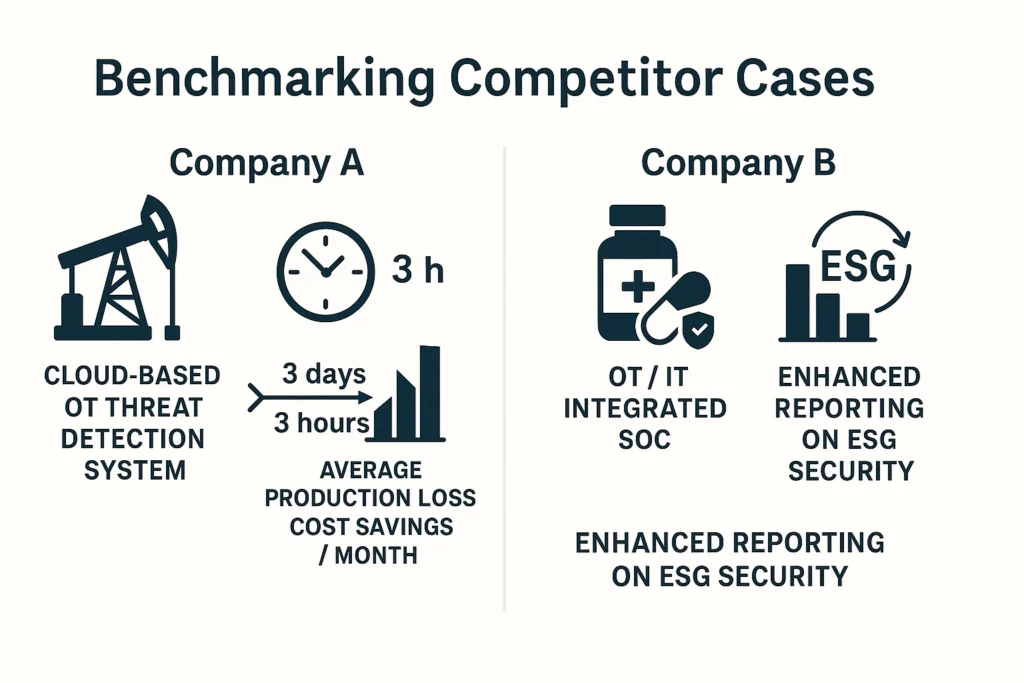
- Implemented a cloud-based OT threat detection system.
- Reduced average incident detection time from 3 days to 3 hours.
- Saved more than 20 million KRW monthly in production loss prevention. (Source: Dragos Case Study – Oil & Gas Sector)
A powerful example of how reducing detection time directly enhances productivity and cuts losses.
2) Company B (Pharmaceutical Sector)
- Built an integrated OT/IT Security Operations Center (SOC).
- Passed two consecutive regulatory audits for compliance with the Serious Accidents Act.
- Reflected strengthened security efforts in its ESG reports. (Source: Claroty Whitepaper – Cybersecurity for Life Sciences)
This demonstrates that OT security investment contributes to gaining investor trust and enhancing ESG metrics, beyond merely preventing cyberattacks.
4. Bridging the Gap Between Practitioners and Executives
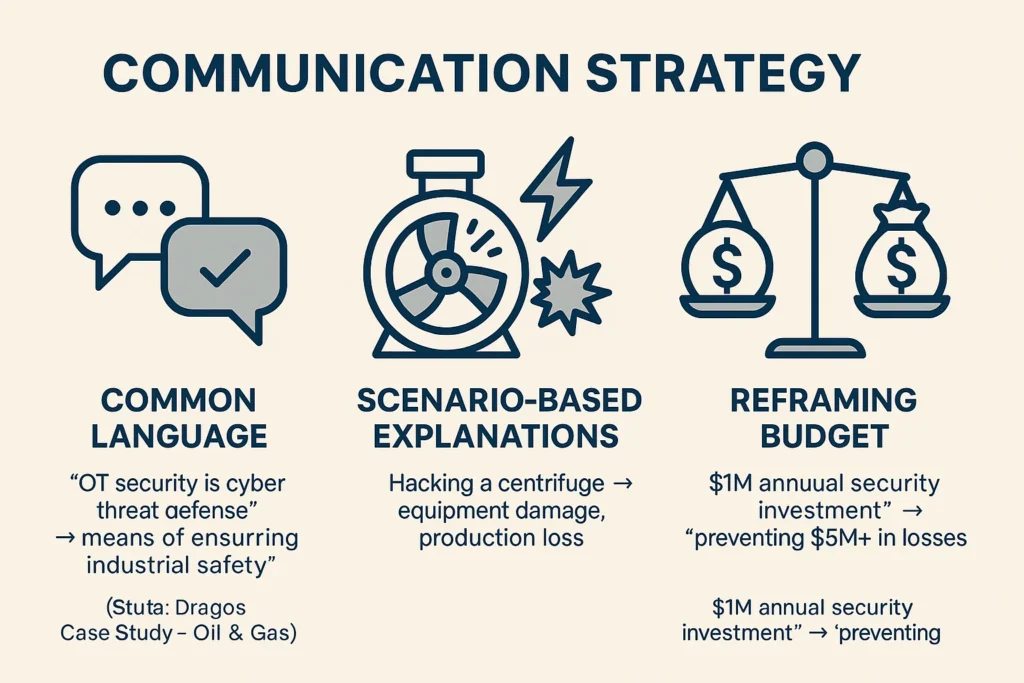
1) Define a Common Language
- Reframe: “OT security is not just cyber defense – it is a means to ensure industrial safety.”
- Reinforce with real-life examples: “A PLC hacking incident could lead directly to human casualties.”
2) Scenario-Based CommunicationConcrete Scenario
- PLC control system hacked,
- Abnormal increase in centrifugal speed,
- Equipment destruction and explosion,
- Full production line shutdown → Losses exceeding several billion KRW.
Presenting vivid, relatable scenarios helps executives truly understand and empathize with the risks.
3) Reframe the Budget Narrative
Position it not as “an annual 100 million KRW cybersecurity cost,”
- But as “an investment that prevents over 500 million KRW in potential losses.”
Clear investment-vs-loss comparison reduces psychological resistance to security funding.
5. Step-by-Step OT Security Implementation Roadmap
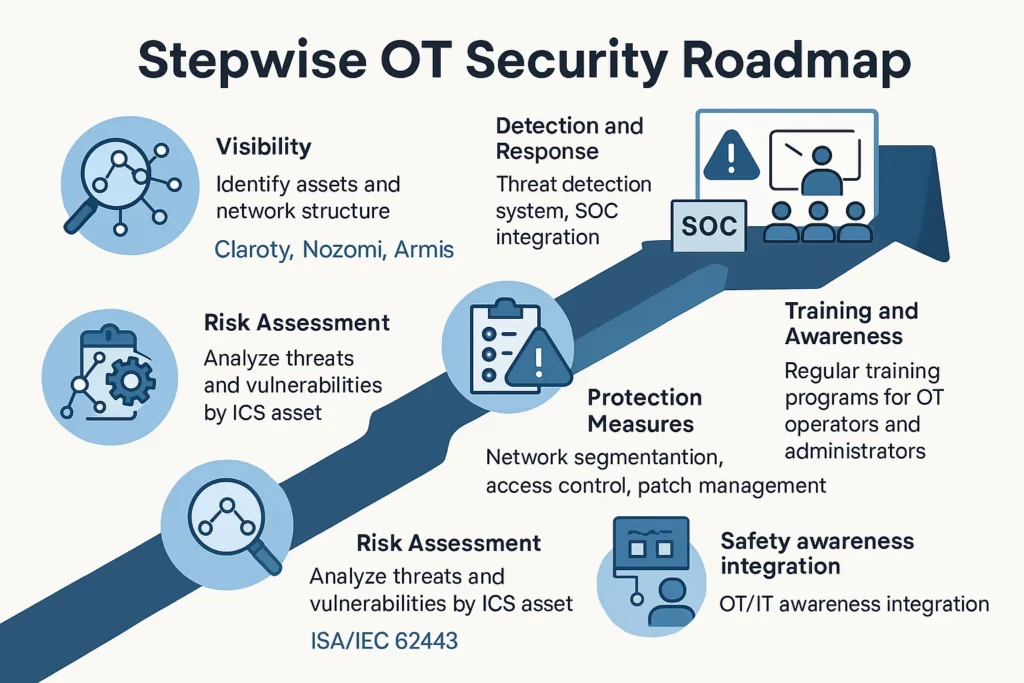
| Phase | Key Activities | Notes |
|---|---|---|
| 1. Visibility | Asset identification and network mapping | Utilize Claroty, Nozomi, Armis |
| 2. Risk Assessment | Analyze threats and vulnerabilities for each ICS asset | Follow ISA/IEC 62443 standards |
| 3. Protection Implementation | Strengthen network segmentation, access control, and patch management | Collaborate with OT operations teams |
| 4. Detection and Response | Deploy threat detection systems and integrate with SOC | Centralize OT/IT monitoring |
| 5. Training and Awareness | Conduct regular cybersecurity education for operators and managers | Integrate with safety training programs |
Conclusion: OT Security Is No Longer an Option – It Is a Survival Strategy
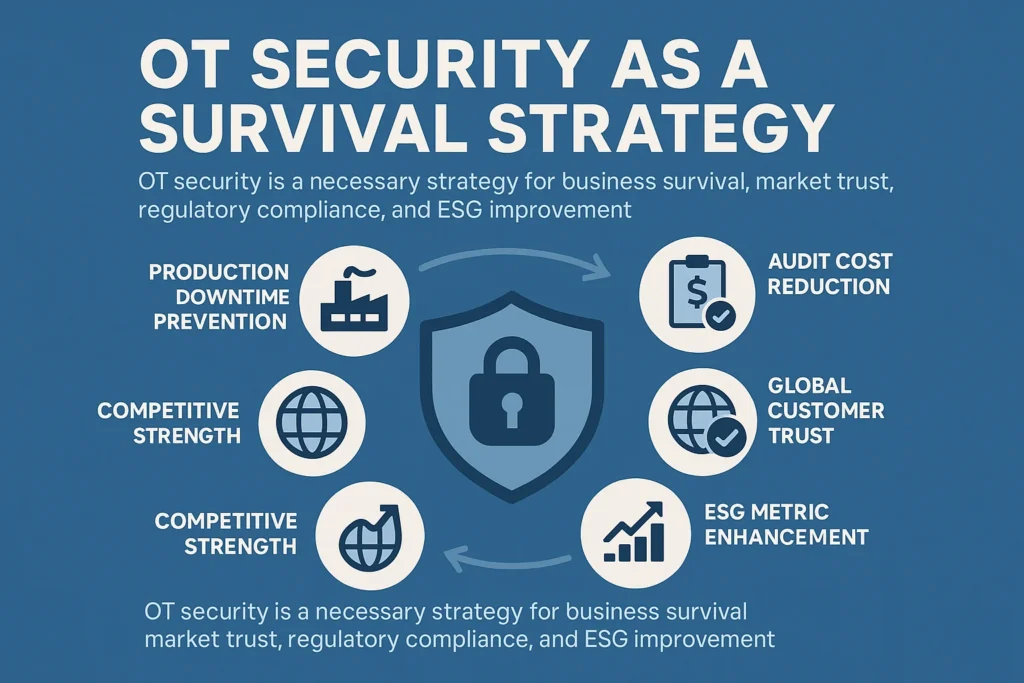
OT security is not merely a defensive tool – it is a critical strategy for:
- Preventing production downtime,
- Reducing audit compliance costs,
- Gaining and maintaining global client trust,
- Enhancing ESG reporting indicators,
- Strengthening global market competitiveness.
Ultimately, everything converges on the essential need for OT security enhancement.
Only companies that fortify OT security will survive and thrive in the future industrial environment.
![[OT Sec] Mastering DNP3: The Core of Industrial Automation Communications](https://ota2z.com/wp-content/uploads/2025/04/DALL·E_2025-04-23_14.36.54_-_Futuristic_industrial_scene_showing_the_evoluti-768x439.webp)
![[OT Sec] Why Network Segmentation (5 Steps) Between OT and IT Is Essential](https://ota2z.com/wp-content/uploads/2025/05/ChatGPT-Image-2025년-5월-11일-오후-06_05_10-768x512.webp)
![[OT Sec] Measures for Cultivating OT Security Experts (1/3)](https://ota2z.com/wp-content/uploads/2025/02/DALL·E_2025-02-03_12.44.29_-_A_dynamic_visual_representation_of_OT_security_-768x439.webp)
![[Physical Sec] “Comprehensive Practical Guide for Physical Security Professionals: Complete Mastery of Special Security Areas from ATMs to High-Rise Buildings”](https://ota2z.com/wp-content/uploads/2025/08/ChatGPT-Image-2025년-8월-5일-오후-08_01_57-768x768.webp)

![[OT보안] “2025년 글로벌 OT 산업 사이버보안 환경: 위협과 기회의 균형점”](https://ota2z.com/wp-content/uploads/2025/08/ChatGPT-Image-2025년-8월-1일-오후-02_57_42-768x768.webp)