[OT Sec] 🚢 UR E26 vs. UR E27: The Two Pillars of Ship Cybersecurity – What’s the Difference? 🔐



Table of Contents
As digital technology advances rapidly, ships are becoming increasingly automated and interconnected via networks. However, this also increases the risk of cyberattacks, which can severely impact vessel operations and safety. To address this, the International Association of Classification Societies (IACS) has introduced UR E26 and UR E27 to enhance the cyber resilience of ships.

Both UR E26 and UR E27 play a vital role in strengthening maritime cybersecurity, but their scopes and requirements differ.
UR E26 addresses overall ship-level cybersecurity governance, while UR E27 focuses on ensuring the security of onboard systems and equipment (CBS – Computer-Based Systems).
This article analyzes the key differences between UR E26 and UR E27 and explains how each is applied in the context of ship cybersecurity.
✅ UR E26 vs. UR E27: What’s the Difference?

| Category | UR E26 | UR E27 |
|---|---|---|
| Purpose | Ensure ship-wide cyber resilience | Strengthen security of onboard systems and equipment |
| Scope | OT and IT systems of the entire ship | Individual onboard systems and CBS equipment |
| Key Requirement | Ship operator must establish cybersecurity management | Equipment manufacturers must comply with cybersecurity standards |
| Related Standards | IMO MSC-FAL.1/Circ.3, IEC 62443, NIST CSF | IEC 62443, ISO 27001, Classification Society Technical Rules |
🔍 1️⃣ Difference in Application Scope
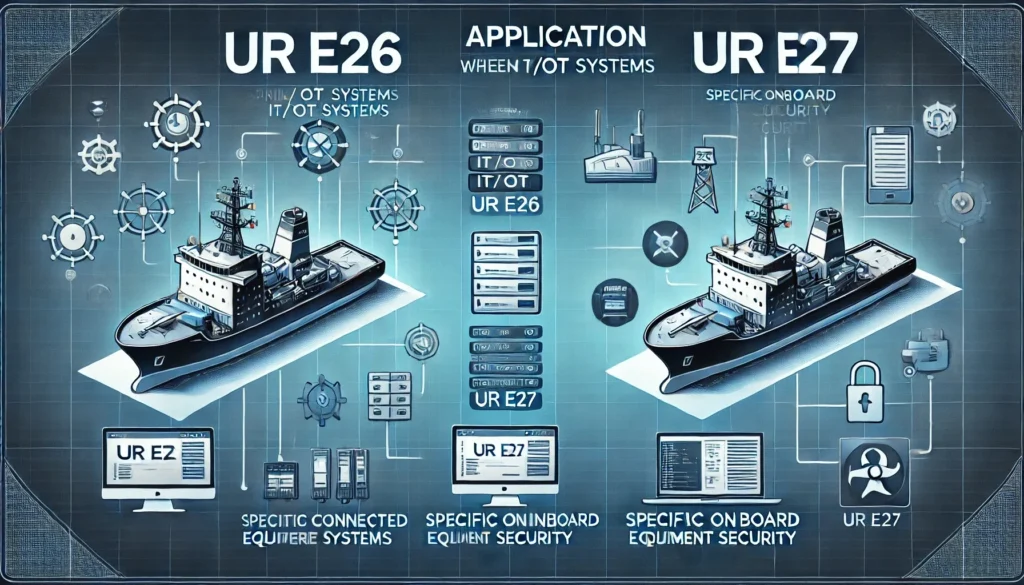
The most significant distinction lies in application coverage.
- UR E26: Covers all OT and IT systems on board. It requires ship operators to establish cybersecurity policies and maintain an integrated protection and management framework for networks and systems.
- UR E27: Focuses on individual onboard systems and equipment (CBS). It mandates equipment manufacturers to implement and maintain cybersecurity functions and provide patching and update capabilities for each device.
In short, UR E26 governs overall cybersecurity management, whereas UR E27 ensures device-level protection and compliance.
🔍 2️⃣ Difference in Security Requirements (Across Key Cyber Domains)

| Security Domain | UR E26 (Ship-Wide) | UR E27 (Onboard Equipment/System) |
|---|---|---|
| Identify | Identify all systems and network assets onboard | Identify security risks of individual CBS/equipment |
| Protect | Implement security zones, access control, and network protection | Apply encryption, secure boot, and hardware-level security controls |
| Detect | Monitor system/network anomalies | Detect internal anomalies and verify system integrity |
| Respond | Establish incident response plans | Isolate and recover compromised individual systems |
| Recover | Apply backup policies and system recovery plans | Ensure backup and restore functions for individual devices |
| Compliance | Ship operator demonstrates compliance | Manufacturer provides product-level security certification |
🔍 3️⃣ Comparative Analysis of Key Requirements
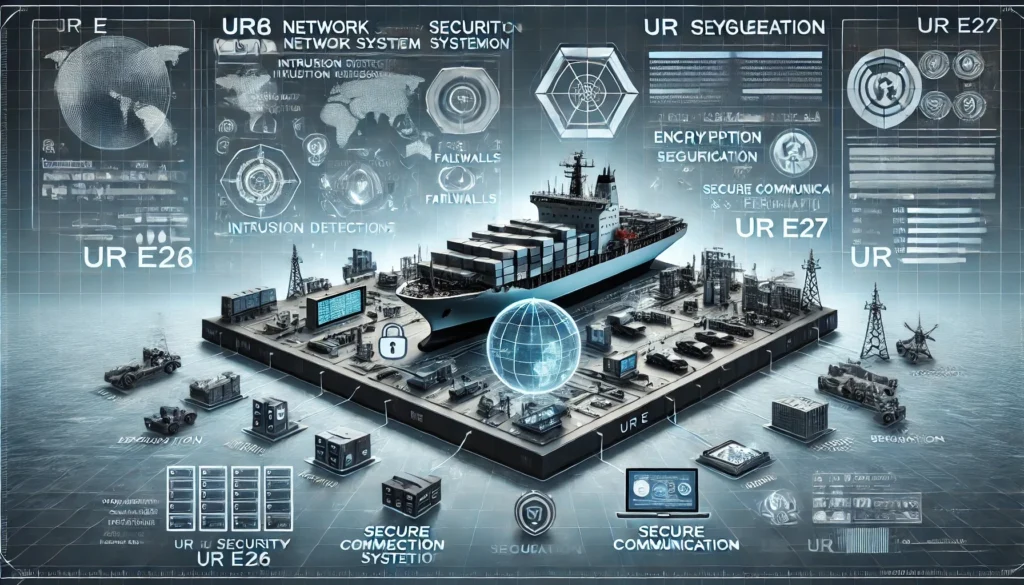
1) Network & System Protection
| Requirement | UR E26 | UR E27 |
|---|---|---|
| Security Zones | Segregate OT and IT into distinct zones | Maintain independent secure environments per device |
| Network Protection | Firewalls, IDS, IPS, and secure network design | Use secure communication protocols between devices |
| Wireless Protection | Secure and isolate wireless networks (Wi-Fi, Bluetooth) | Encrypt and authenticate wireless interfaces on equipment |
2) Vulnerability Management & Security Updates
| Requirement | UR E26 | UR E27 |
|---|---|---|
| Vulnerability Management | Identify and respond to system-wide vulnerabilities | Manage vulnerabilities and apply patches for each device |
| Security Updates | Implement update policies for systems and networks | Maintain firmware/software updates for individual equipment |
3) Compliance & Certification
| Requirement | UR E26 | UR E27 |
|---|---|---|
| EU Declaration of Conformity (DoC) | Ship operator must prove security compliance | Manufacturer must obtain product certification |
| Audit Readiness | Operator undergoes regular cybersecurity audits | Equipment must pass product-level security assessments |
🚀 Conclusion: Two Complementary Frameworks
UR E26 and UR E27 represent two complementary pillars of maritime cybersecurity.
- UR E26 requires ship operators to establish a robust ship-wide cybersecurity management framework.
- UR E27 requires equipment manufacturers to ensure the security of individual onboard devices and systems.
🔑 Thus, ship operators must comply with UR E26 for comprehensive ship-level security, while manufacturers must adhere to UR E27 to ensure equipment-level protection and compliance.
Together, these frameworks form a holistic cybersecurity strategy for modern ships operating in the digital age.


