[OT Sec] OT Security Consultant’s Practical Procedure A to Z (1/2)


Table of Contents
Introduction: A Survival Strategy in the Digital Era – The Starting Point of OT Security Consulting
In the wave of the Fourth Industrial Revolution and digital transformation, OT (Operational Technology) systems have become the foundation across industries such as manufacturing, energy, chemicals, plants, and smart factories. Technologies like PLC (Programmable Logic Controller), SCADA (Supervisory Control and Data Acquisition), and HMI (Human Machine Interface) are essential for achieving automation and operational efficiency. However, alongside these advancements lies a growing security risk.
Previously, physical security and air-gapped architectures offered some level of protection for OT environments. Today, integration with IT networks through cloud connectivity, IoT-based sensors, and remote maintenance access has made OT systems increasingly vulnerable to external attacks. Cyberattacks targeting industrial control systems have grown more sophisticated, and OT security incidents now result in physical consequences such as production halts, equipment damage, or safety hazards, not just data breaches.
So how can organizations identify and manage these risks in advance? The answer is OT security consulting. More than just technical diagnostics, OT security consulting involves understanding on-site operations and designing practical security strategies tailored to real-world environments.
While many companies recognize the need for OT security, they often don’t know where to start. IT security approaches are rarely applicable in OT settings where even a minor security change can disrupt operations. This is where OT security consultants play a critical role by bridging the gap between technology, operations, and business.
This post outlines the 8 key phases of an OT security consultant’s process—from analysis to execution—offering a roadmap for companies new to OT security or those aiming to enhance their existing systems.
By following these steps, your organization can begin building a secure and efficient digital operation that mitigates OT-related risks. OT security isn’t just technology—it’s a strategic advantage and survival necessity.
Step 1: Understanding Client Needs and Initial Meeting – Securing the First Button in Security
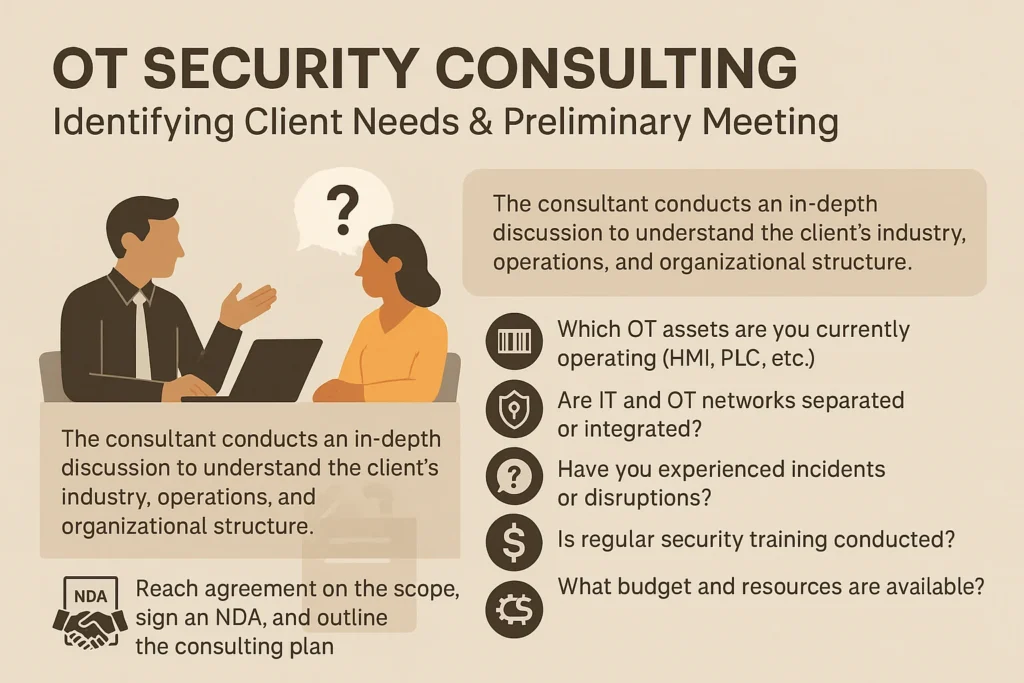
OT security consulting begins not with analysis, but with in-depth dialogue. The goal of this phase is to understand the client’s specific needs and current security status to define the direction of the consultation.
Consultants typically hold preliminary meetings with executives or IT/OT teams to understand the organization’s structure and operations. OT infrastructure varies widely across industries—whether manufacturing, energy, or industrial plants—and so do asset criticality and sensitivity.
Key questions discussed during this phase include:
- “What OT assets (HMI, PLC, SCADA, etc.) are currently operated?”
- “What security systems or policies are in place?”
- “Have there been any internal security incidents or suspicious behavior recently?”
Through these discussions, consultants narrow the scope of analysis and identify unseen vulnerabilities. Sometimes clients believe they have no issues, only for serious weaknesses to be uncovered.
An NDA (Non-Disclosure Agreement) is signed, and the project schedule is coordinated. Administrative matters such as communication channels, data access scope, and required documentation are also arranged.
This is not merely a preliminary step; it’s a strategic phase that determines project success. It aligns expectations with reality and sets clear goals for meaningful improvement. From this point forward, the consultant becomes a trusted partner within the organization.
Step 2: On-Site Inspection and Asset Identification – Confronting the Reality of Security
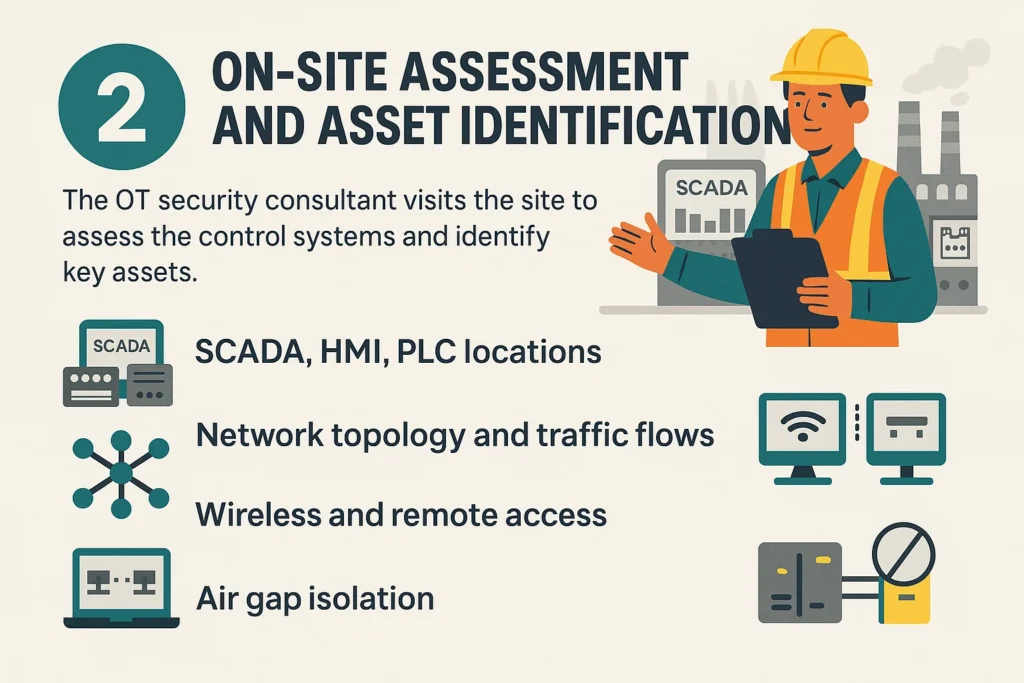
The most hands-on phase of OT security consulting is the on-site inspection. This is where consultants move beyond documents to physically observe the system’s operating environment, often uncovering insights not visible in diagrams or floor plans.
During the visit, consultants inspect key OT assets like HMI terminals, PLCs, and SCADA systems to map their physical locations, communication paths, and external connectivity. OT environments often include a mix of decades-old and cutting-edge equipment, which complicates accurate assessment from documentation alone.
Key inspection checkpoints include:
- Physical layout and power status of SCADA, HMI, and PLC assets
- Verification of actual cabling vs. documented network diagrams
- Identification of wireless equipment and remote access points
- Evaluation of whether air-gaps are truly maintained or only appear to be
- Check for unsecured interfaces like USB or serial ports
Workers often ask, “Why do you need to look at this?” But in OT security, it’s precisely the “obvious connections” that hackers exploit. A single USB for backup or a wireless router for maintenance can open the door for intrusion.
Consultants also conduct informal interviews to uncover undocumented practices. Statements like “This unit was connected last week but isn’t now,” or “We’ll reconnect this after process changes,” are invaluable.
The goal here isn’t just asset listing—it’s understanding how systems actually operate and where real exposure exists. This becomes the foundation for the next steps: risk analysis and security scenario development. A misunderstood infrastructure will render any future recommendations ineffective.
Step 3: Risk Analysis and Security Assessment – Exposing the Core of Cyber Threats
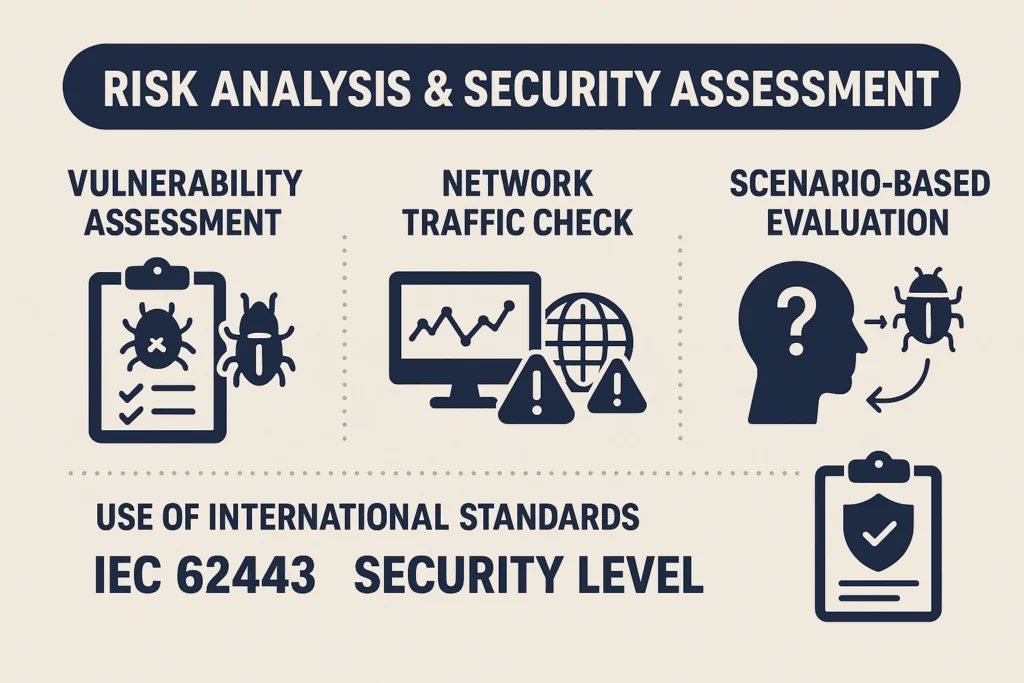
Following the site visit, consultants move into one of the most technical and experience-driven stages: risk analysis and security assessment.
First comes vulnerability analysis. Consultants compare asset software versions with the CVE (Common Vulnerabilities and Exposures) database to identify known risks. Outdated firmware or weak password policies could indicate critical vulnerabilities. Open or unused ports and excessive permissions are red flags.
Next is network flow analysis. Consultants assess actual data traffic against intended architecture to find anomalies—such as unexpected internet access or unauthorized internal communication. Tools like Wireshark or OT-specific traffic visualization software assist in this phase.
The point isn’t just what is connected, but why. For instance, if an industrial machine connects to the internet despite no operational need, it’s a serious security concern.
Consultants then simulate real attack paths via scenario-based analysis. They answer questions like, “If malware enters via this port, how would it spread to SCADA systems?” This is often visualized as a threat exposure map.
Such evaluations are aligned with global standards like IEC 62443, helping to quantify current security levels and identify gaps toward the Target Security Level (SL-T). These insights form the blueprint for tailored security strategies and solutions.
Ultimately, this stage is about revealing invisible threats. Once risks are made visible, they become manageable.
Step 4: Reporting – Turning Data into Actionable Stories
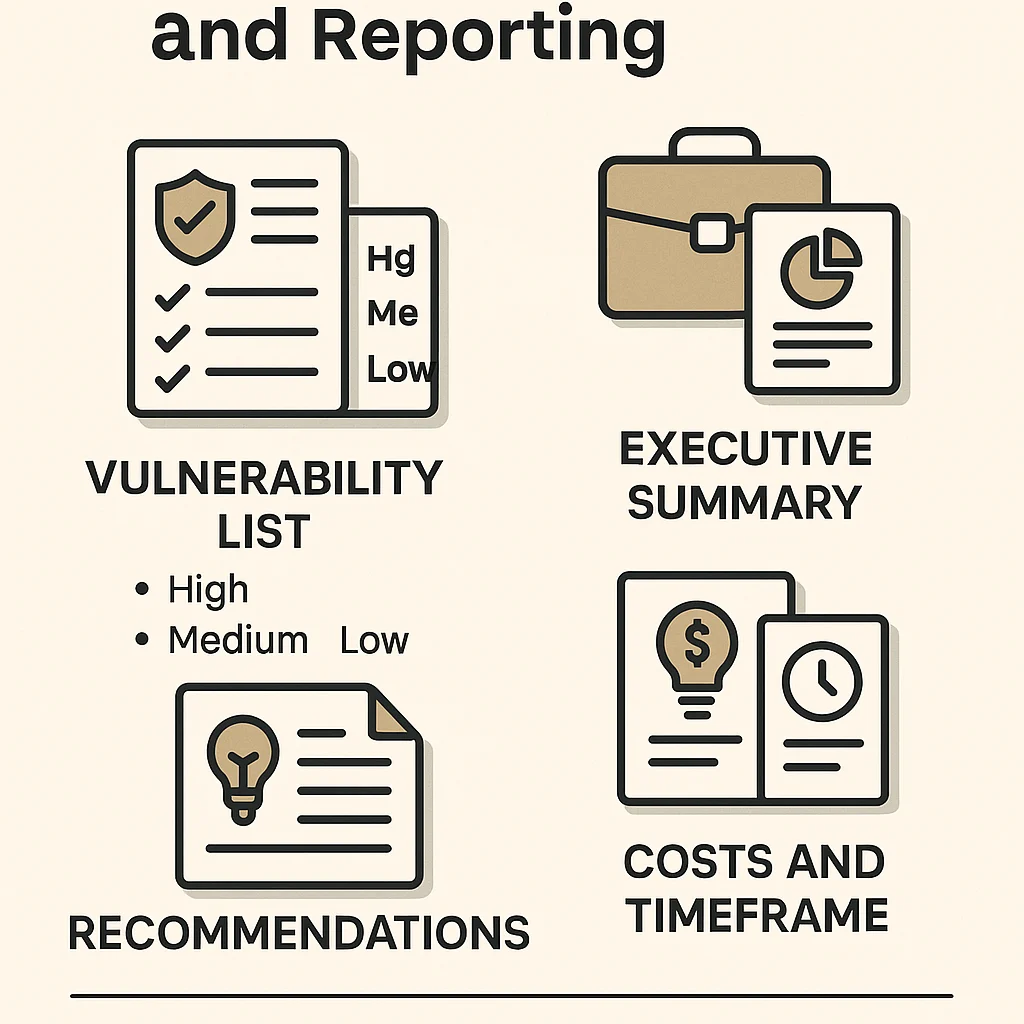
After completing the diagnosis, findings must be translated into a clear, structured report that both technical staff and executives can act upon.
Vulnerabilities are classified into High, Medium, and Low risk levels, with each entry including:
- Asset and location
- Vulnerability description
- Potential attack scenario and impact
- Current status and urgency of response
Each issue is paired with actionable recommendations. For example: “Apply firmware update v3.1—2 hours estimated, no downtime.”
Reports are dual-language: technical reports (ports, logs, signatures) for engineers and executive summaries for managers (risk overview, cost estimates, strategic advice).
A comprehensive report includes:
- Project overview and goals
- Diagnosis scope and method
- Key findings summary
- Risk-tiered vulnerability list
- Recommendations and how-to guides
- Cost and ROI projections
- Suggested timeline and execution plan
Recommendations are prioritized as short, mid, and long-term based on impact and feasibility.
Lastly, consultants present the findings to clients, clarifying details and answering questions. This ensures that recommendations lead to action—not just knowledge.
This step marks the shift from analysis to implementation, and a well-written report often determines the success of the entire OT security project.
5 recommended external English resources for deepening your understanding of OT security consulting and industrial cybersecurity:
- NIST SP 800-82 Rev. 3 – Guide to Operational Technology (OT) Security
🔗 https://csrc.nist.gov/publications/detail/sp/800-82/rev-3/final
A comprehensive guide from the U.S. National Institute of Standards and Technology (NIST) covering security best practices for industrial control systems. - SANS Institute – Industrial Control Systems Security Resources
🔗 https://www.sans.org/ics/
Offers training programs, tools, and whitepapers focused on ICS and OT cybersecurity. - ISA/IEC 62443 – Industrial Automation and Control Systems Security Standards
🔗 https://www.isa.org/standards-and-publications/isa-standards/isa-iec-62443-series-of-standards
Official portal for the IEC 62443 family of OT security standards maintained by ISA. - CISA – Industrial Control Systems (ICS) Security
🔗 https://www.cisa.gov/industrial-control-systems
Cybersecurity and Infrastructure Security Agency (CISA) provides tools, alerts, and guidelines for protecting critical OT environments. - Dragos – OT Cybersecurity Threat Intelligence and Reports
🔗 https://www.dragos.com/resources/
Insightful threat reports, blogs, and technical analyses by one of the leading OT security companies.
![[OT보안] “제조업 OT 보안 위기, 통합 프레임워크로 해결하다”](https://ota2z.com/wp-content/uploads/2025/08/ChatGPT-Image-2025년-8월-1일-오후-07_10_23-768x768.webp)
![[OT Sec] Strategic Framework for Justifying OT Security Investment: A Deep-Dive Guide for Executive Persuasion](https://ota2z.com/wp-content/uploads/2025/04/ChatGPT-Image-2025년-4월-26일-오전-11_34_29-768x512.webp)
![[OT Sec] Measures for Cultivating OT Security Experts (3/3)](https://ota2z.com/wp-content/uploads/2025/02/DALL·E_2025-02-03_15.21.47_-_A_government-supported_OT_security_education_in-768x439.webp)
![[네트워크] 네트워크 전문가를 위한 OSI 7계층 실무 가이드: 우체국 시스템으로 이해하는 네트워크 아키텍처](https://ota2z.com/wp-content/uploads/2025/08/ChatGPT-Image-2025년-8월-15일-오후-03_39_56-768x768.webp)

![[Mac Safety] “Lathe vs. Milling vs. CNC: Everything You Need to Know”](https://ota2z.com/wp-content/uploads/2025/04/ChatGPT-Image-2025년-4월-5일-오후-02_11_00-768x512.webp)