[OT Sec] “OT Security Consulting: 10 Field Realities and a Battle-Tested Solution Roadmap”


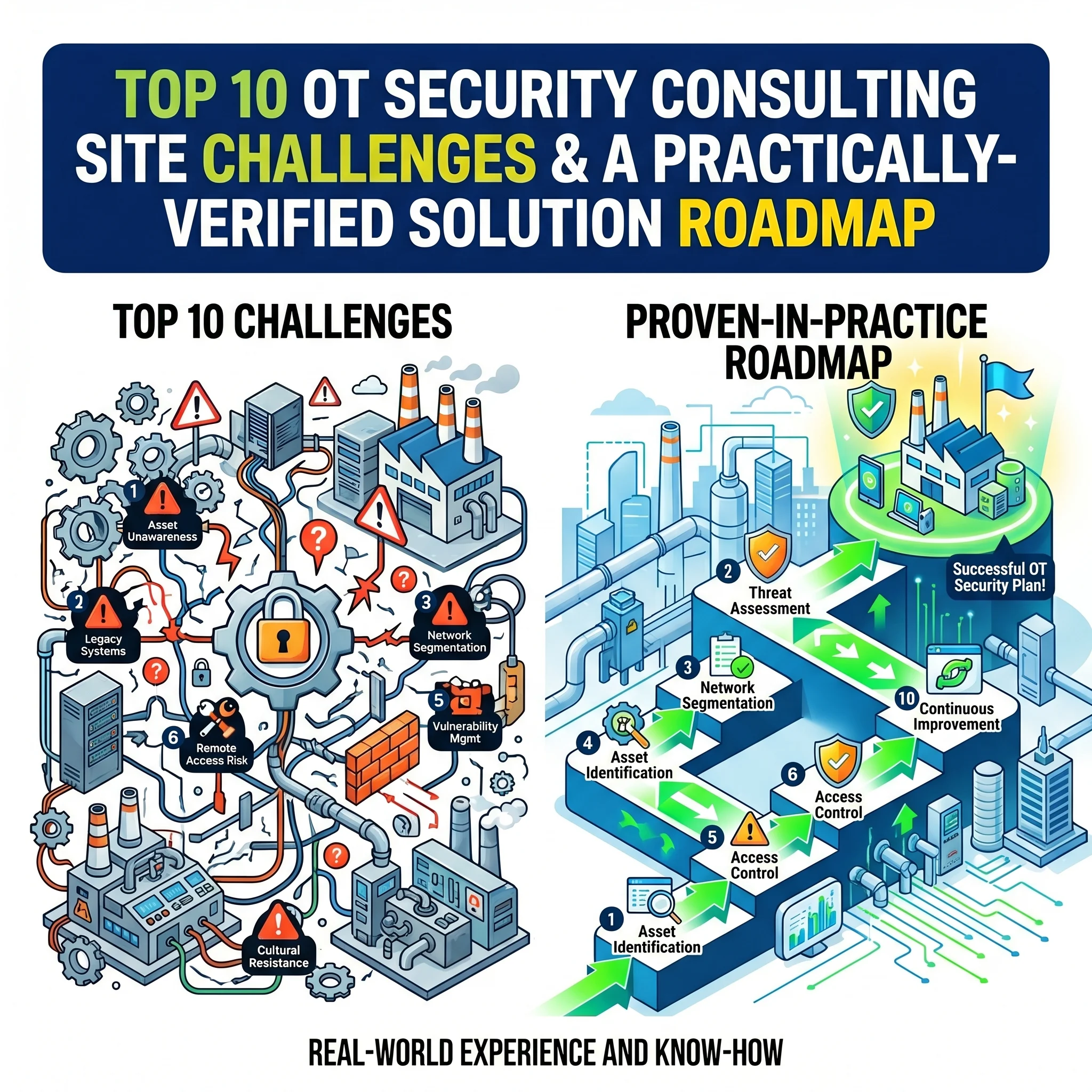
OT Security Consulting: 10 Field Realities and a Battle-Tested Solution Roadmap
On the factory floor, OT security is a problem of awareness, budget, organization, and regulation long before it is a problem of technology. Here are the ten walls consultants hit again and again — and the data-validated solutions, organized into four practical tracks.
When you start an OT security project on a manufacturing floor, you hit a wall harder than any technical vulnerability before you even begin the assessment: the question, “Why would we ever be hacked?” In an environment where neither operators nor executives see plant equipment as a target, the first gap a consultant must close is one of awareness, not code. And this gap is not unique to any single country. According to the IBM X-Force Threat Intelligence Index 2026, manufacturing has been the most attacked industry in the world for five consecutive years, accounting for 27.7% of all tracked incidents. OT security, in other words, is no longer “someone else’s factory” — it is the reality of the number-one target. This article distills the ten recurring challenges of OT security consulting into four actionable solution tracks, grounded in public global data and real project experience.
01From the Air-Gap Myth to ROI — Why OT Security Is Always Deprioritized
Infographic ① Three Awareness & Budget Traps and Their Fixes
The first wall is the air-gap myth. The belief that “OT systems are isolated from the internet, so they’re safe” runs deep, yet in reality most plants are already exposed through remote maintenance lines, vendor VPNs, and USB media. The solution is not abstract warnings but a visualized network map of actual connection paths laid out in front of the executive team. Awareness only moves when each external touchpoint is proven with data and peer-industry ransomware shutdowns are translated into hard costs. Regular red-team (penetration test) reports keep that awareness from being a one-time event.
The second wall is the difficulty of proving ROI. Because security is seen as an investment “proven only after an incident,” persuading SME executives who prioritize productivity and delivery is hard. Effective OT security proposals convert ROI into Annualized Loss Expectancy (ALE) — one hour of lost production multiplied by breach probability turns a vague threat into a number. Adding cyber-insurance premium savings and contract retention from passing large-customer supply-chain security audits reframes security as revenue defense, not cost. Government subsidies and tax credits to lower the upfront burden complete the case.
The third wall is the smart-factory subsidy paradox. Government build-out programs have rapidly expanded OT network connectivity, but security-by-design requirements are often token or absent — a “connected but unsecured” structure effectively mass-produced with public funds. The fix is Security by Design from the outset: new projects should embed security requirements directly into subsidy applications, while already-built sites are addressed through separate post-hoc assessment and hardening engagements.
02Unpatchable Equipment and Invisible Assets — Technical Controls That Work
Infographic ② Three Stages of Non-Intrusive Technical Control
The phrase you hear most often on-site is “this equipment can’t be patched.” Many PLCs, HMIs, and SCADA systems run on legacy embedded OSes, and contractual structures that void equipment certification upon patching leave known vulnerabilities in place. Here the correct OT security move is not forced patching but compensating controls: segment legacy equipment into a dedicated VLAN/zone, isolate it with a unidirectional gateway (data diode) and an industrial firewall, and block known attacks via IPS-signature virtual patching. Writing “obligation to support security patches and maintain certification” into new equipment contracts cuts the root cause.
But one thing must come before all of this: asset visibility. Many companies cannot say how many PLCs they run, which firmware versions are in place, or what is connected to what. In the PwC 2026 Global Digital Trust Insights survey, 35% of respondents reported insufficient visibility of OT/IIoT assets. Without an asset inventory, vulnerability management, anomaly detection, and incident response are all impossible — which is why the first phase of any OT security project should always be auto-inventorying PLCs, firmware, and traffic flows with a passive asset-discovery solution and building a baseline alongside manual surveys.
The third technical challenge is the availability-first culture. On the floor, uptime is money, and stopping a line for inspection, patching, or segmentation leads to delivery delays and penalties — so sites refuse security measures outright. The way through is to apply non-disruptive, passive methods first. Mirror-port-based passive monitoring detects assets and anomalies without halting a line. Patches and inspections align with planned-maintenance windows, and controls roll out in phases starting from redundant segments — earning trust by beginning with measures that never threaten availability. That unauthorized external access accounted for half of all incidents in the SANS survey, while only 13% of organizations had fully implemented advanced access controls like session recording, shows that non-intrusive controls are precisely the most urgent gap.
03The Responsibility Gap Between IT and OT — Redesigning Governance
Infographic ③ Governance Structure That Closes the Responsibility Gap
The most structural challenge in OT security is the responsibility gap. The IT security team says “plant equipment isn’t our jurisdiction,” while the production team says “security is IT’s job” — and in the gap between them, there is often no one dedicated to OT security at all. The solution is to establish unified governance reporting to the CISO. In the Fortinet 2025 survey, the share of organizations placing OT security under the CISO jumped from 16% in 2022 to 52% in 2025, showing that industrial cyber risk is rising to the board level. Codify OT security responsibilities in a RACI matrix, run a converged-security council with IT, production, and engineering, and — where no dedicated staff exist — cross-train the IT security team on OT or outsource to an external MSSP.
Another organizational challenge is vendor lock-in. When the equipment vendor solely holds the remote-access account under the banner of maintenance, the SME is trapped in a structure where it cannot touch the equipment without the vendor — control effectively sits outside the company, and demands to “tighten account management” can even be met with threats to cancel the maintenance contract. The fix is to govern remote access through a vendor-dedicated jump server and PAM (Privileged Access Management): record every session, allow access only on approval, and time-box connections. More fundamentally, including security requirements in bid-evaluation criteria for new orders restores negotiating leverage, and a multi-vendor strategy eases single-source dependence — bringing OT security control back inside.
04Regulatory Blind Spots and the Talent Cliff — Structural Fixes
Infographic ④ External Incentives and Talent Strategy
Unlike large enterprises, defense, and finance, most SME manufacturers fall outside any legal OT security mandate. “If the law doesn’t compel it, we don’t do it” is the reality, and voluntary security is hard to expect. The way past this regulatory blind spot is to import the incentive from outside. The supply-chain security demands of prime contractors are the strongest lever: once a prime begins auditing its suppliers, security becomes a de facto requirement even without a legal mandate. Positioning ISA/IEC 62443 certification or an information-security management system as a competitive edge for winning contracts — and framing tightening regulation as grounds for getting ahead — creates the motive for voluntary investment.
The final challenge is the absolute shortage of specialists. OT security is a demanding domain requiring IT security, control-system (ICS), and manufacturing-process knowledge simultaneously. Genuine experts are scarce, and the compensation SMEs can offer rarely secures them; even outsourced consulting often yields token IT-centric deliverables. The answer is to combine internal development with external outsourcing: invest in OT training (IEC 62443 credentials, SANS ICS courses) to grow existing IT security staff into hybrid talent, and outsource the gap to OT-specialized MSSPs vetted for control-system and process understanding, with screening criteria to filter out token deliverables. That organizations involving field technicians and operators in incident-response exercises were 1.7 times more likely to report strong readiness shows the core of any talent strategy is bringing “people who know the floor” into security.
05Conclusion — Start With Non-Intrusive Foundations, Reframe as Competitiveness
The core of the solutions across all ten challenges comes down to two points. First, start with foundational work that never threatens availability — network segmentation, passive monitoring, and asset visibility — rather than intrusive measures like forced patching or line stoppages. The sequence of making things visible, isolating them, and watching them earns floor trust and rapidly raises incident-response capability. Second, reframe OT security from “cost” to “competitiveness and loss prevention.” Manufacturing’s five-year run as the #1 target, downtime costs running into hundreds of thousands of dollars per hour, and prime contractors’ supply-chain security demands all point to OT security no longer being optional. The four walls — awareness, budget, organization, and regulation — are ultimately people problems, and they fall only when you persuade with data and work through them step by step alongside the floor. The decisive factor in OT security, as the field teaches again and again, is not the flashiest solution but the most basic visibility.
References
- IBM X-Force Threat Intelligence Index 2026 — ibm.com/reports/threat-intelligence
- IBM Cost of a Data Breach Report 2025 — ibm.com/reports/data-breach
- SANS 2025 State of ICS/OT Security Report — sans.org
- Fortinet 2025 State of Operational Technology and Cybersecurity Report — fortinet.com
- Dragos 2026 OT/ICS Cybersecurity Year in Review — dragos.com
- PwC 2026 Global Digital Trust Insights — pwc.com
- Aberdeen / Siemens manufacturing downtime cost estimates — smartindustry.com
![[OT Sec] Measures for Cultivating OT Security Experts (1/3)](https://ota2z.com/wp-content/uploads/2025/02/DALL·E_2025-02-03_12.44.29_-_A_dynamic_visual_representation_of_OT_security_-768x439.webp)

![[OT 보안] “ISA/IEC 62443 산업제어시스템 보안 표준 완전 가이드: IACS 보안 레벨과 위험 평가 실무를 위한 필수 지침서”](https://ota2z.com/wp-content/uploads/2025/08/ChatGPT-Image-2025년-8월-14일-오후-05_33_15-768x768.webp)
![[Physical Sec] PSP Certification Mastery: Complete Practice Guide for Physical Security Professionals](https://ota2z.com/wp-content/uploads/2025/09/ChatGPT-Image-2025년-7월-27일-오후-10_25_00-768x768.webp)

